state.rs defines all the mutable data that the evaluator carries through an
expansion run: configuration, the scope stack of variables and macros, the
source-file registry, and call-site records for the tracing infrastructure.
Design rationale
Scope stack instead of a hash-chain
EvaluatorState keeps a Vec<ScopeFrame>. Each macro call pushes a new
ScopeFrame and pops it on return. Variable and macro lookups walk the
stack from top (innermost scope) to bottom (global scope), returning the first
match. This gives correct lexical shadowing without the overhead of cloning
entire hash maps or maintaining parent pointers.
%export exploits the flat Vec: it copies a binding one index down
(stack_len - 2) into the parent frame, making the binding survive the
child’s pop.
TrackedValue: three span-density levels
TrackedValue wraps a String value with a Vec<SpanRange> that carries
source attribution:
-
Empty spans — untracked (Rhai/Python script result). The value is pushed to the output sink as
push_untracked, contributing no source information. -
One coarse span covering
[0, value.len()]— the fast path. The tracer knows the value came from a particular token but does not record per-character attribution. -
Multiple spans — full per-token threading. Each element covers a sub-range of
valueand attributes it to a different source token. This is produced only on thePreciseTracingOutputpath when argument evaluation returns aVec<SpanRange>.
SourceManager: u32 indices into a byte registry
SourceManager stores raw Vec<u8> (not String) because the lexer operates
on byte slices. Each source file gets a u32 index that fits in Token.src.
Canonical paths are used as the deduplication key so that including the same
file through two different relative paths resolves to the same index.
VarDefRaw / MacroDefRaw: call-site byte offsets
These records capture the exact byte position of every %set or %def call
so that the MCP tracing tools can answer "where was this variable set?" or
"where was this macro defined?" without a full re-parse.
State type overview
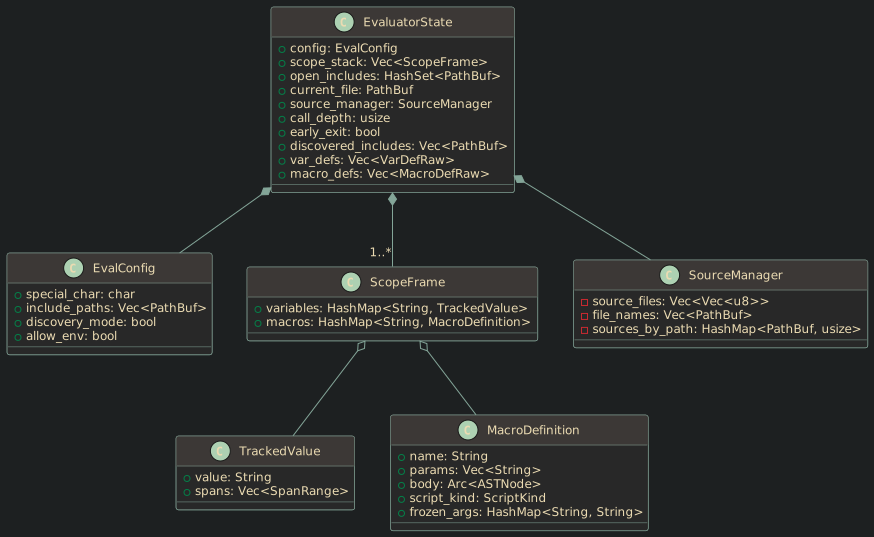
File structure
// <<@file weaveback-macro/src/evaluator/state.rs>>=
// <<state preamble>>
// <<eval config>>
// <<script kind>>
// <<macro definition>>
// <<tracked value>>
// <<scope frame>>
// <<source manager>>
// <<var def raw>>
// <<macro def raw>>
// <<max recursion>>
// <<evaluator state>>
// @
Preamble
// <<state preamble>>=
// crates/weaveback-macro/src/evaluator/state.rs
use crate;
use crateASTNode;
use ;
use PathBuf;
use Arc;
// @EvalConfig — per-run configuration
EvalConfig is created once per evaluation run (or shared across a batch of
files via eval_files). It is immutable after construction; all mutable
per-call state lives in EvaluatorState.
discovery_mode is a special flag used by the directory-scan driver: instead
of recursively evaluating %include/%import files, the evaluator records the
resolved paths in discovered_includes and returns. This allows collecting
all input file dependencies without side effects.
allow_env gates access to environment variables via %env(NAME). It is
disabled by default so templates cannot silently exfiltrate secrets without
an explicit --allow-env flag.
// <<eval config>>=
// @ScriptKind — which engine evaluates a macro body
After the body text is expanded (variable substitution etc.), ScriptKind
determines whether the result is returned as-is (None) or passed through
a scripting engine (Rhai, Python).
// <<script kind>>=
// @MacroDefinition — stored macro
MacroDefinition is cloned out of the scope stack at every call site.
body is an Arc<ASTNode> so cloning is cheap (no deep copy of the AST).
frozen_args is populated by Evaluator::freeze_macro_definition when a
macro is exported via %export. It maps variable names that appear in the
body (but are not declared parameters) to their values at export time,
implementing a lexical closure without a reference to the enclosing scope.
// <<macro definition>>=
// @TrackedValue — value with optional source attribution
// <<tracked value>>=
// @ScopeFrame — one lexical scope level
Each macro call creates a new ScopeFrame. A frame holds the variables bound
by that call’s parameter list (and by %set calls within the macro body) and
any macros defined inside the call body via %def.
// <<scope frame>>=
// @SourceManager — source file registry
SourceManager stores the raw bytes of every source file that has been read
during this evaluation run. Files are deduplicated by canonical path so that
including the same file through two different relative paths yields the same
u32 index.
// <<source manager>>=
// @VarDefRaw and MacroDefRaw — call-site records
These lightweight structs record the byte position of every %set and %def
call encountered during evaluation. The MCP server drains them after each run
to build the var_defs_map and macro_defs_map that answer "where was this
symbol defined?".
// <<var def raw>>=
/// Raw record of a `%set(var_name, ...)` call site, captured during evaluation.
/// Positions are absolute byte offsets in the source file (same as Token.pos / Token.length).
// @
// <<macro def raw>>=
/// Raw record of a `%def / %rhaidef / %pydef(name, ...)` call site.
// @Recursion depth guard
// <<max recursion>>=
pub use MAX_RECURSION_DEPTH;
// @EvaluatorState — full mutable evaluation state
EvaluatorState owns all mutable state. Evaluator (in core.rs) holds an
EvaluatorState plus the stateless singletons (RhaiEvaluator,
MontyEvaluator, builtins map).
The helper methods on EvaluatorState encapsulate common patterns: the three
set_*_variable variants manage the span-density levels of TrackedValue,
and get_variable / get_macro both walk the scope stack from top to bottom.
// <<evaluator state>>=
// @