The weaveback-macro lexer converts a raw &str into a flat Vec<Token> that the parser then assembles into a tree. It is a hand-written pushdown scanner: a state stack allows blocks, macro argument lists, and block comments to nest arbitrarily. The special character (default %, configurable) acts as the sole escape sigil — everything else is plain text.

Design rationale

Why a state stack?

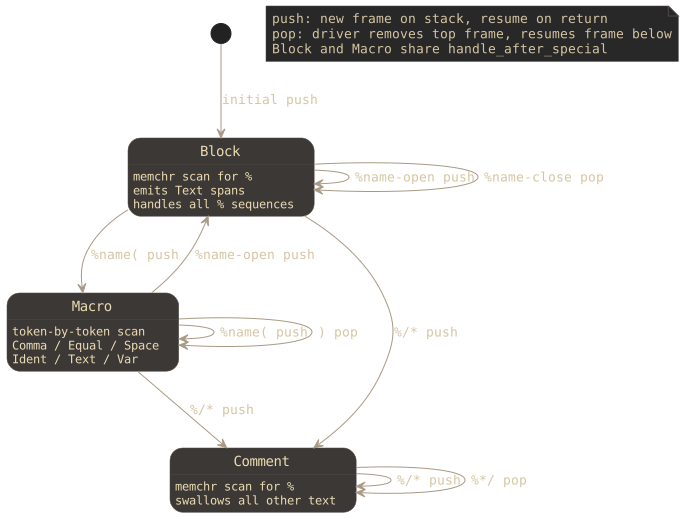
Weaveback constructs nest: a macro call can contain a named block that contains another macro call that contains a comment. A finite-state scanner cannot count nesting depth. A stack of State frames solves this cleanly: push on open, pop on close. Each frame records the byte offset of its opening delimiter so that "Unclosed block at offset N" errors point to the right place.

Why memchr in Block and Comment?

Weaveback documents are mostly plain text. The special character appears rarely. Scanning byte-by-byte for % wastes cycles on the common case. memchr compiles to a SIMD/vectorised search on every major platform and locates the next % in O(n/16) wall-clock time. Macro arg lists are short and contain many token types, so a simple loop is used there instead.

Why SpecialAction?

Both Block and Macro states must handle a % in their input. The full dispatch logic lives in handle_after_special, shared by both states. The return value — a SpecialAction enum — tells the caller what to do: push a new state and return immediately, pop the current state, or continue the loop.

Why plain text for %identifier?

%identifier not followed by (, {, or } is not a macro call. Emitting it as Text (no error) allows weaveback documents to contain printf-style specifiers (%d, %s), shell constructs (%T), version tags, and similar, without noise. Only the structurally significant combinations trigger the lexer’s machinery.

Why precompute comment delimiters?

The comment delimiters %/* and %*/ depend on the runtime special char. Precomputing them as open_comment: [u8; 3] and close_comment: [u8; 3] avoids rebuilding the arrays on every call to run_comment_state.

Token vocabulary

TokenKind Sequence Meaning

Text

any

Literal pass-through content

Space

whitespace run

Whitespace inside macro args (preserved)

Special

%

Escaped special char → literal % in output

BlockOpen

%{ / %name{

Opens a named or anonymous block

BlockClose

%} / %name}

Closes the innermost open block

Macro

%name(

Macro call head; starts arg-list scanning

Var

%(name)

Variable substitution

Ident

[A-Za-z_][…]

Identifier inside a macro arg list

Comma

,

Arg separator inside a macro arg list

CloseParen

)

Closes the current macro arg list

Equal

=

Named-arg = inside a macro arg list

LineComment

%// / %-- / %#

Single-line comment (consumed to \n)

CommentOpen

%/*

Opens a nestable block comment

CommentClose

%*/

Closes the innermost open block comment

EOF

end of input

Sentinel; always the last token

State machine

Three mutually-recursive states share the same stack. The driver loop dispatches to the correct handler and pops the stack when the handler returns false.
PlantUML diagram

File Structure

The single output file assembles all chunks in declaration order.

// <<@file weaveback-macro/src/lexer/mod.rs>>=
// crates/weaveback-macro/src/lexer/mod.rs — generated from lexer.adoc
// <<lexer preamble>>

// <<lexer char classifiers>>

// <<lexer state types>>

// <<lexer struct>>

// <<lexer impl>>
// @

impl Lexer structure

Every method group gets its own sub-chunk. They are assembled here in the order they appear in the impl block.

// <<lexer impl>>=
impl<'a> Lexer<'a> {
    // <<lexer pub api>>

    // <<lexer input helpers>>

    // <<lexer emission>>

    // <<lexer run>>

    // <<lexer block state>>

    // <<lexer macro state>>

    // <<lexer special handler>>

    // <<lexer comment state>>
}
// @

Module preamble

// <<lexer preamble>>=
use crate::types::{LexerError, Token, TokenKind};
use memchr::memchr;

#[cfg(test)]
mod tests;
// @

Character classifiers

Three byte-level predicates used throughout the lexer. They operate on u8 rather than char because the lexer works on raw bytes — only ASCII sequences are structurally significant, and non-ASCII bytes are always part of plain text.

// <<lexer char classifiers>>=
fn is_identifier_start(b: u8) -> bool {
    matches!(b, b'a'..=b'z' | b'A'..=b'Z' | b'_')
}

fn is_identifier_continue(b: u8) -> bool {
    matches!(b, b'a'..=b'z' | b'A'..=b'Z' | b'0'..=b'9' | b'_')
}

fn is_whitespace(b: u8) -> bool {
    matches!(b, b' ' | b'\t' | b'\r' | b'\n')
}
// @

State types

State

Each frame on the stack is one of three variants. Block and Macro carry the byte offset of their opening delimiter so that EOF-unclosed errors report the right position. Comment omits an offset because it self-reports its own "Unclosed comment" error from inside run_comment_state, using the start of the comment body.

SpecialAction

handle_after_special is called by both run_block_state and run_macro_state after consuming the special char. The three variants encode exactly what the caller must do next:

  • Push — a new state was just pushed; return true immediately so the driver dispatches to the new state without re-entering the current loop.

  • Pop — a closing delimiter was seen; return false so the driver pops the current frame.

  • Continue — a token was emitted; continue the current loop.

// <<lexer state types>>=
#[derive(Debug, Clone, Copy, PartialEq)]
enum State {
    /// Opening byte offset of the `%{` or `%name{`.
    Block(usize),
    /// Opening byte offset of the `%name(`.
    Macro(usize),
    /// Comment state self-reports its own unclosed error.
    Comment,
}

/// What `handle_after_special` tells the caller to do.
#[derive(Debug, Clone, Copy, PartialEq)]
enum SpecialAction {
    /// A new state was pushed; return `true` to keep the current state active.
    Push,
    /// A block was closed; return `false` to pop the current state.
    Pop,
    /// A token was emitted; continue the loop.
    Continue,
}
// @

The Lexer struct

bytes and pos are the cursor into the input. src is a 32-bit file index threaded into every Token for source-map purposes. state_stack starts with one State::Block(0) — the implicit outermost block — so that top-level text and constructs are handled identically to nested ones.

open_comment and close_comment are the precomputed 3-byte delimiters for the configurable special char (see Design rationale).

// <<lexer struct>>=
pub struct Lexer<'a> {
    bytes: &'a [u8],
    pos: usize,
    src: u32,
    tokens: Vec<Token>,
    /// ASCII special character (e.g. `%`).
    special_char: u8,
    state_stack: Vec<State>,
    pub errors: Vec<LexerError>,
    /// Precomputed `[sc, b'/', b'*']` — checked in comment state.
    open_comment: [u8; 3],
    /// Precomputed `[sc, b'*', b'/']`.
    close_comment: [u8; 3],
}
// @

Public API

new validates the special char is ASCII (the SIMD memchr path only works on single bytes), precomputes the comment delimiters, and seeds the stack with the outermost Block frame.

lex consumes the lexer and returns the completed token stream alongside any errors. Errors are non-fatal: the stream is always well-formed up to EOF even when errors occur.

// <<lexer pub api>>=
pub fn new(input: &'a str, special_char: char, src: u32) -> Self {
    assert!(special_char.is_ascii(), "special_char must be ASCII");
    let sc = special_char as u8;
    let mut lexer = Lexer {
        bytes: input.as_bytes(),
        pos: 0,
        src,
        tokens: Vec::new(),
        special_char: sc,
        state_stack: Vec::new(),
        errors: Vec::new(),
        open_comment: [sc, b'/', b'*'],
        close_comment: [sc, b'*', b'/'],
    };
    lexer.state_stack.push(State::Block(0));
    lexer
}

pub fn lex(mut self) -> (Vec<Token>, Vec<LexerError>) {
    self.run();
    (self.tokens, self.errors)
}
// @

Input helpers

Six small utilities used throughout the state handlers.

peek_byte and advance form the basic cursor. advance returns the consumed byte so callers can avoid a second peek.

skip_line_comment uses memchr to jump past the entire line in one call — useful for all three line-comment styles (%//, %--, %#).

get_identifier_end finds the end of an ASCII identifier without allocating. It is used both to scan macro names and to extract the tag from named blocks.

block_tag_at reads the identifier immediately after a % at a given byte offset. Named-block open and close use this to match tags (%blk{…​%blk}) without storing the tag in the State frame.

// <<lexer input helpers>>=
// ── Low-level cursor ──────────────────────────────────────────────────

fn peek_byte(&self) -> Option<u8> {
    self.bytes.get(self.pos).copied()
}

fn advance(&mut self) -> Option<u8> {
    let b = self.bytes.get(self.pos).copied()?;
    self.pos += 1;
    Some(b)
}

/// Advance past the rest of the current line (through `\n` or to EOF).
fn skip_line_comment(&mut self) {
    let rest = &self.bytes[self.pos..];
    match memchr(b'\n', rest) {
        Some(i) => self.pos += i + 1,
        None => self.pos = self.bytes.len(),
    }
}

/// Returns the byte index just past the end of an identifier starting at `start`.
fn get_identifier_end(&self, start: usize) -> usize {
    let bytes = self.bytes;
    if start >= bytes.len() || !is_identifier_start(bytes[start]) {
        return start;
    }
    let mut end = start + 1;
    while end < bytes.len() && is_identifier_continue(bytes[end]) {
        end += 1;
    }
    end
}

fn starts_with_bytes(&self, pat: &[u8]) -> bool {
    self.bytes[self.pos..].starts_with(pat)
}

/// Extract the identifier tag from a `%tag{` or `%tag}` position.
/// `pct_start` is the byte offset of `%`. Returns `""` for anonymous `%{`/`%}`.
fn block_tag_at(&self, pct_start: usize) -> &str {
    let start = pct_start + 1; // skip `%`
    let mut end = start;
    while end < self.bytes.len() && is_identifier_continue(self.bytes[end]) {
        end += 1;
    }
    std::str::from_utf8(&self.bytes[start..end]).unwrap_or("")
}
// @

Token and error emission

emit_token suppresses zero-length tokens except for EOF, which is always required as the stream terminator. This keeps the token stream clean without forcing callers to check lengths.

error_at appends to errors. Errors never stop lexing — the lexer always produces a usable stream.

// <<lexer emission>>=
// ── Emission ──────────────────────────────────────────────────────────

fn emit_token(&mut self, pos: usize, length: usize, kind: TokenKind) {
    if length == 0 && kind != TokenKind::EOF {
        return;
    }
    self.tokens.push(Token { kind, src: self.src, pos, length });
}

fn error_at(&mut self, pos: usize, message: &str) {
    self.errors.push(LexerError { pos, message: message.to_string() });
}
// @

Main driver

run is the top-level dispatch loop. It terminates when pos reaches the end of input — not when the stack empties. This ensures that even a malformed (unclosed) document is fully scanned.

At EOF, any frames above the root block (state_stack[1..]) are unclosed. The driver collects their error messages by borrowing state_stack immutably before calling error_at mutably — the collect() into a Vec breaks the simultaneous borrow. Comment frames are omitted here because run_comment_state reports its own unclosed error when it hits EOF.

// <<lexer run>>=
// ── Main driver ───────────────────────────────────────────────────────

pub fn run(&mut self) {
    loop {
        // EOF is driven by input exhaustion, not by stack state.
        if self.pos >= self.bytes.len() {
            // Collect before borrowing &mut self for error_at.
            let unclosed: Vec<(String, usize)> = self.state_stack
                .get(1..)
                .unwrap_or(&[])
                .iter()
                .filter_map(|s| match s {
                    State::Block(p) => {
                        let tag = self.block_tag_at(*p);
                        let msg = if tag.is_empty() {
                            "Unclosed anonymous block '%{'".to_string()
                        } else {
                            format!("Unclosed block '%{}{{'", tag)
                        };
                        Some((msg, *p))
                    }
                    State::Macro(p) => {
                        Some(("Unclosed macro argument list".to_string(), *p))
                    }
                    State::Comment => None, // self-reported by run_comment_state
                })
                .collect();
            for (msg, pos) in unclosed {
                self.error_at(pos, &msg);
            }
            self.emit_token(self.pos, 0, TokenKind::EOF);
            return;
        }
        let state = match self.state_stack.last().copied() {
            Some(s) => s,
            None => {
                // Stack underflow before EOF — push/pop bug.
                self.error_at(self.pos, "internal error: state stack underflow");
                self.emit_token(self.pos, 0, TokenKind::EOF);
                return;
            }
        };
        let keep_state = match state {
            State::Block(_) => self.run_block_state(),
            State::Macro(_) => self.run_macro_state(),
            State::Comment => self.run_comment_state(),
        };
        if !keep_state {
            self.state_stack.pop();
        }
    }
}
// @

Block state

Block is the default state and the most common. memchr locates the next special char in O(n/vector_width) time, skipping over all intervening text. If no special char is found before EOF the remaining bytes are emitted as a single Text token.

When a special char is found, the text up to it is emitted, then the char is consumed and control passes to handle_after_special. The return value determines whether to push (return true immediately so the driver calls the new state), pop (return false), or stay in the loop.

// <<lexer block state>>=
// ── Block state ───────────────────────────────────────────────────────

fn run_block_state(&mut self) -> bool {
    let sc = self.special_char;
    loop {
        let rest = &self.bytes[self.pos..];
        let text_len = match memchr(sc, rest) {
            Some(i) => i,
            None => {
                if !rest.is_empty() {
                    self.emit_token(self.pos, rest.len(), TokenKind::Text);
                    self.pos = self.bytes.len();
                }
                return false;
            }
        };
        if text_len > 0 {
            self.emit_token(self.pos, text_len, TokenKind::Text);
            self.pos += text_len;
        }
        let pct_start = self.pos;
        self.advance(); // consume the special char
        match self.handle_after_special(pct_start) {
            SpecialAction::Push => return true,
            SpecialAction::Pop => return false,
            SpecialAction::Continue => {}
        }
    }
}
// @

Macro arg state

Macro arg lists are scanned token-by-token. ) ends the list (pops the frame), , and = are single-character tokens, whitespace runs are collapsed into one Space token, ASCII identifiers become Ident, and everything else — including non-ASCII text and numeric literals — becomes Text.

A % inside a macro arg list is valid: it can start a nested macro call, a block, a comment, a variable substitution, or an escape. Delegation to handle_after_special handles all of these uniformly.

The trailing check if !matches!(self.state_stack.last(), Some(State::Macro(_))) handles the case where handle_after_special called Pop (e.g. a %} inside a macro arg): in that case, we are no longer the active state and must return false without consuming ).

// <<lexer macro state>>=
// ── Macro arg state ───────────────────────────────────────────────────

fn run_macro_state(&mut self) -> bool {
    let sc = self.special_char;
    while let Some(b) = self.peek_byte() {
        if b == b')' {
            let start = self.pos;
            self.advance();
            self.emit_token(start, 1, TokenKind::CloseParen);
            return false;
        } else if b == b',' {
            let start = self.pos;
            self.advance();
            self.emit_token(start, 1, TokenKind::Comma);
        } else if b == b'=' {
            let start = self.pos;
            self.advance();
            self.emit_token(start, 1, TokenKind::Equal);
        } else if is_whitespace(b) {
            let ws_start = self.pos;
            while self.peek_byte().is_some_and(is_whitespace) {
                self.advance();
            }
            self.emit_token(ws_start, self.pos - ws_start, TokenKind::Space);
        } else if b == sc {
            let pct_start = self.pos;
            self.advance();
            match self.handle_after_special(pct_start) {
                SpecialAction::Push => return true,
                SpecialAction::Pop => return false,
                SpecialAction::Continue => {}
            }
        } else if is_identifier_start(b) {
            let start = self.pos;
            let end = self.get_identifier_end(start);
            self.pos = end;
            self.emit_token(start, end - start, TokenKind::Ident);
        } else {
            let start = self.pos;
            while let Some(b2) = self.peek_byte() {
                if is_whitespace(b2)
                    || matches!(b2, b')' | b',' | b'=')
                    || b2 == sc
                {
                    break;
                }
                self.advance();
            }
            self.emit_token(start, self.pos - start, TokenKind::Text);
        }

        if !matches!(self.state_stack.last(), Some(State::Macro(_))) {
            return false;
        }
    }
    // EOF without closing ')'.
    if let Some(&State::Macro(open_pos)) = self.state_stack.last() {
        self.error_at(open_pos, "Unclosed macro argument list");
    }
    false
}
// @

Shared special dispatcher

handle_after_special is the heart of the lexer. It is called by both Block and Macro states after the special char has been consumed, and decides what to emit and whether to push or pop.

The dispatch table (by the next byte):

Next byte Action

(

%(varname) variable substitution — delegated to handle_var

{

Anonymous block open — push State::Block

}

Block close — pop current frame

/

Line (%//) or block (%/*) comment; %/* pushes State::Comment

-

Line comment %--

#

Line comment %#

sc

Escaped special char %Special token

identifier start

Named macro %name(, named block %name{/%name}, or plain text

anything else

Error + emit % as Text; unrecognised byte left for next iteration

EOF

Emit % as Text

handle_var handles the %(name) form: it demands an identifier immediately after ( and a ) immediately after the identifier. Any deviation produces an error and emits the malformed sequence as Text.

// <<lexer special handler>>=
// ── Shared special-sequence handler ──────────────────────────────────
//
// Called after the special char has been consumed.
// `pct_start` is the byte offset of the special char itself.

fn handle_after_special(&mut self, pct_start: usize) -> SpecialAction {
    let sc = self.special_char;
    match self.peek_byte() {
        Some(b'(') => {
            self.handle_var(pct_start);
            SpecialAction::Continue
        }
        Some(b'{') => {
            self.advance();
            self.emit_token(pct_start, self.pos - pct_start, TokenKind::BlockOpen);
            self.state_stack.push(State::Block(pct_start));
            SpecialAction::Push
        }
        Some(b'}') => {
            if self.state_stack.len() <= 1 {
                self.error_at(pct_start, "Unmatched block close: no open block");
            }
            self.advance();
            self.emit_token(pct_start, self.pos - pct_start, TokenKind::BlockClose);
            SpecialAction::Pop
        }
        Some(b'/') => {
            self.advance();
            match self.peek_byte() {
                Some(b'/') => {
                    self.advance();
                    self.skip_line_comment();
                    self.emit_token(pct_start, self.pos - pct_start, TokenKind::LineComment);
                }
                Some(b'*') => {
                    self.advance();
                    self.emit_token(pct_start, self.pos - pct_start, TokenKind::CommentOpen);
                    self.state_stack.push(State::Comment);
                    return SpecialAction::Push;
                }
                _ => {
                    self.error_at(
                        pct_start,
                        &format!(
                            "Unexpected char after '{}/': expected // or /*",
                            sc as char
                        ),
                    );
                    self.emit_token(pct_start, self.pos - pct_start, TokenKind::Text);
                }
            }
            SpecialAction::Continue
        }
        Some(b'-') => {
            self.advance();
            match self.peek_byte() {
                Some(b'-') => {
                    self.advance();
                    self.skip_line_comment();
                    self.emit_token(pct_start, self.pos - pct_start, TokenKind::LineComment);
                }
                _ => {
                    self.error_at(
                        pct_start,
                        &format!(
                            "Unexpected char after '{}-': expected --",
                            sc as char
                        ),
                    );
                    self.emit_token(pct_start, self.pos - pct_start, TokenKind::Text);
                }
            }
            SpecialAction::Continue
        }
        Some(b'#') => {
            self.advance();
            self.skip_line_comment();
            self.emit_token(pct_start, self.pos - pct_start, TokenKind::LineComment);
            SpecialAction::Continue
        }
        Some(b) if b == sc => {
            self.advance();
            self.emit_token(pct_start, self.pos - pct_start, TokenKind::Special);
            SpecialAction::Continue
        }
        Some(b) if is_identifier_start(b) => {
            let id_end = self.get_identifier_end(self.pos);
            self.pos = id_end;
            match self.peek_byte() {
                Some(b'(') => {
                    self.advance();
                    self.emit_token(pct_start, self.pos - pct_start, TokenKind::Macro);
                    self.state_stack.push(State::Macro(pct_start));
                    SpecialAction::Push
                }
                Some(b'{') => {
                    self.advance();
                    self.emit_token(pct_start, self.pos - pct_start, TokenKind::BlockOpen);
                    self.state_stack.push(State::Block(pct_start));
                    SpecialAction::Push
                }
                Some(b'}') => {
                    if self.state_stack.len() <= 1 {
                        self.error_at(pct_start, "Unmatched block close: no open block");
                    }
                    self.advance();
                    self.emit_token(pct_start, self.pos - pct_start, TokenKind::BlockClose);
                    SpecialAction::Pop
                }
                _ => {
                    // %identifier not followed by ( { } — pass through as plain text.
                    self.emit_token(pct_start, self.pos - pct_start, TokenKind::Text);
                    SpecialAction::Continue
                }
            }
        }
        Some(_) => {
            // % followed by an unrecognized byte — emit just the % as Text with an error.
            // The unrecognized byte is left for the next iteration.
            self.error_at(
                pct_start,
                &format!("Unrecognized char after '{}'", sc as char),
            );
            self.emit_token(pct_start, 1, TokenKind::Text);
            SpecialAction::Continue
        }
        None => {
            // % at EOF — emit as plain text.
            self.emit_token(pct_start, 1, TokenKind::Text);
            SpecialAction::Continue
        }
    }
}

/// Handle a `%(varname)` sequence. `pct_start` is the byte offset of the `%`.
fn handle_var(&mut self, pct_start: usize) {
    let sc = self.special_char as char;
    self.advance(); // consume '('
    let ident_start = self.pos;
    let ident_end = self.get_identifier_end(ident_start);
    if ident_end > ident_start {
        self.pos = ident_end;
        if self.peek_byte() == Some(b')') {
            self.advance();
            self.emit_token(pct_start, self.pos - pct_start, TokenKind::Var);
            return;
        }
        self.error_at(pct_start, "Var missing closing ')'");
    } else {
        self.error_at(
            pct_start,
            &format!("Var missing identifier after '{}('", sc),
        );
    }
    self.emit_token(pct_start, self.pos - pct_start, TokenKind::Text);
}
// @

Comment state

Block comments nest: %/* outer %/* inner %*/ outer %*/ is valid. The comment state therefore pushes itself on %/* and pops on %*/, exactly like the Block state does for %{/%}.

memchr is used here too — comment bodies can be long. Any % that is not part of %/* or %*/ is silently skipped (the pos += 1 at the end of the loop body). This is why a bare % inside a comment is harmless: it is neither a comment delimiter nor a syntax error.

On EOF, the accumulated text (if any) is emitted and an "Unclosed comment" error is recorded. The frame is then popped by returning false.

// <<lexer comment state>>=
// ── Comment state ─────────────────────────────────────────────────────

fn run_comment_state(&mut self) -> bool {
    let sc = self.special_char;
    const DELIM_LEN: usize = 3; // [sc, x, y]
    let comment_text_start = self.pos;

    loop {
        // Jump to the next special char — only it can start a delimiter.
        let rest = &self.bytes[self.pos..];
        let Some(i) = memchr(sc, rest) else {
            break; // EOF inside comment
        };
        self.pos += i;

        if self.starts_with_bytes(&self.open_comment) {
            if self.pos > comment_text_start {
                self.emit_token(
                    comment_text_start,
                    self.pos - comment_text_start,
                    TokenKind::Text,
                );
            }
            let delim_start = self.pos;
            self.pos += DELIM_LEN;
            self.emit_token(delim_start, DELIM_LEN, TokenKind::CommentOpen);
            self.state_stack.push(State::Comment);
            return true;
        }
        if self.starts_with_bytes(&self.close_comment) {
            if self.pos > comment_text_start {
                self.emit_token(
                    comment_text_start,
                    self.pos - comment_text_start,
                    TokenKind::Text,
                );
            }
            let delim_start = self.pos;
            self.pos += DELIM_LEN;
            self.emit_token(delim_start, DELIM_LEN, TokenKind::CommentClose);
            return false;
        }
        // Special char that isn't a comment delimiter — skip past it.
        self.pos += 1;
    }

    // EOF: unclosed comment.
    if self.pos > comment_text_start {
        self.emit_token(
            comment_text_start,
            self.pos - comment_text_start,
            TokenKind::Text,
        );
    }
    self.error_at(comment_text_start, "Unclosed comment");
    false
}
// @

Tests

The test module exercises each token kind, error path, and edge case in isolation. Key cases worth noting:

  • test_bare_percent_inside_comment — verifies that a lone % inside a block comment is swallowed as text, not treated as an error or comment delimiter.

  • test_printf_format_specifiers — ensures %d, %s, %f, and similar pass through without errors.

  • test_nested_comment — exercises the comment push/pop path.

  • test_real_world_macro_with_block_and_vars — a realistic %def invocation with a named block containing variable references.

  • test_escaped_pubfunc_not_macro%name( must produce a Special token followed by Text, not a macro call.

// <<@file weaveback-macro/src/lexer/tests.rs>>=
// crates/weaveback-macro/src/lexer/tests.rs

use crate::lexer::Lexer;
use crate::types::{Token, TokenKind};

/// Collect tokens from the lexer (non-EOF tokens only).
fn collect_tokens_with_timeout(input: &str) -> Result<Vec<Token>, String> {
    let (tokens, errors) = Lexer::new(input, '%', 0).lex();
    if !errors.is_empty() {
        // Errors are non-fatal for these tests; just return what was produced.
        let _ = errors;
    }
    Ok(tokens
        .into_iter()
        .filter(|t| t.kind != TokenKind::EOF)
        .collect())
}

/// Helper to assert tokens match an expected sequence of (TokenKind, &str).
/// We compare both `kind` and the `length` of the text (since we can't store real text easily).
fn assert_tokens(input: &str, expected: &[(TokenKind, &str)]) {
    let result = collect_tokens_with_timeout(input).expect("Failed to collect tokens");
    let tokens = result;

    assert_eq!(
        tokens.len(),
        expected.len(),
        "Wrong number of tokens: expected {}, got {}. Tokens: {:?}",
        expected.len(),
        tokens.len(),
        tokens
    );

    for (i, (token, (exp_kind, exp_text))) in tokens.iter().zip(expected.iter()).enumerate() {
        assert_eq!(
            token.kind, *exp_kind,
            "Token {} kind mismatch: expected {:?}, got {:?}",
            i, exp_kind, token.kind
        );
        let got_len = token.length;
        let exp_len = exp_text.len();
        assert_eq!(
            got_len, exp_len,
            "Token {} length mismatch: expected {}, got {} (expected text='{}')",
            i, exp_len, got_len, exp_text
        );
    }
}

//-------------------------------------------------------------------------
// Tests
//-------------------------------------------------------------------------

#[test]
fn test_error_cases() {
    assert_tokens(
        "%{incomplete",
        &[
            (TokenKind::BlockOpen, "%{"),
            (TokenKind::Text, "incomplete"),
        ],
    );
    assert_tokens(
        "%macro(incomplete",
        &[
            (TokenKind::Macro, "%macro("),
            (TokenKind::Ident, "incomplete"),
        ],
    );
    assert_tokens(
        "%/* unfinished",
        &[
            (TokenKind::CommentOpen, "%/*"),
            (TokenKind::Text, " unfinished"),
        ],
    );
}

#[test]
fn test_bare_percent_inside_comment() {
    assert_tokens(
        "%/* 100% done %*/",
        &[
            (TokenKind::CommentOpen, "%/*"),
            (TokenKind::Text, " 100% done "),
            (TokenKind::CommentClose, "%*/"),
        ],
    );
    let (_, errors) = Lexer::new("%/* 100% done %*/", '%', 0).lex();
    assert!(errors.is_empty(), "unexpected errors: {:?}", errors);
}

#[test]
fn test_nested_comment() {
    let input = "%/* outer comment %/* inner %*/ outer %*/";
    assert_tokens(
        input,
        &[
            (TokenKind::CommentOpen, "%/*"),
            (TokenKind::Text, " outer comment "),
            (TokenKind::CommentOpen, "%/*"),
            (TokenKind::Text, " inner "),
            (TokenKind::CommentClose, "%*/"),
            (TokenKind::Text, " outer "),
            (TokenKind::CommentClose, "%*/"),
        ],
    );
}

#[test]
fn test_unfinished_special() {
    assert_tokens("%something", &[(TokenKind::Text, "%something")]);
}

#[test]
fn test_percent_identifier_no_error() {
    let (_, errors) = Lexer::new("%something", '%', 0).lex();
    assert!(errors.is_empty(), "expected no errors for %identifier, got: {:?}", errors);
}

#[test]
fn test_percent_identifier_mid_text() {
    assert_tokens(
        "%something more text",
        &[
            (TokenKind::Text, "%something"),
            (TokenKind::Text, " more text"),
        ],
    );
}

#[test]
fn test_printf_format_specifiers() {
    let input = "%d %s %f";
    let (_, errors) = Lexer::new(input, '%', 0).lex();
    assert!(errors.is_empty(), "expected no errors for printf specifiers, got: {:?}", errors);
    assert_tokens(
        input,
        &[
            (TokenKind::Text, "%d"),
            (TokenKind::Text, " "),
            (TokenKind::Text, "%s"),
            (TokenKind::Text, " "),
            (TokenKind::Text, "%f"),
        ],
    );
}

#[test]
fn test_simple_completion() {
    let result = collect_tokens_with_timeout("a");
    assert!(result.is_ok());
}

#[test]
fn test_basic_tokens() {
    assert_tokens(
        "Hello %name(world)",
        &[
            (TokenKind::Text, "Hello "),
            (TokenKind::Macro, "%name("),
            (TokenKind::Ident, "world"),
            (TokenKind::CloseParen, ")"),
        ],
    );
}

#[test]
fn test_comments() {
    assert_tokens(
        "text %// line comment\nmore text",
        &[
            (TokenKind::Text, "text "),
            (TokenKind::LineComment, "%// line comment\n"),
            (TokenKind::Text, "more text"),
        ],
    );
    assert_tokens(
        "before %/* multi\nline %*/ after",
        &[
            (TokenKind::Text, "before "),
            (TokenKind::CommentOpen, "%/*"),
            (TokenKind::Text, " multi\nline "),
            (TokenKind::CommentClose, "%*/"),
            (TokenKind::Text, " after"),
        ],
    );
}

#[test]
fn test_nested_blocks() {
    assert_tokens(
        "%{outer %{inner%}%}",
        &[
            (TokenKind::BlockOpen, "%{"),
            (TokenKind::Text, "outer "),
            (TokenKind::BlockOpen, "%{"),
            (TokenKind::Text, "inner"),
            (TokenKind::BlockClose, "%}"),
            (TokenKind::BlockClose, "%}"),
        ],
    );
}

#[test]
fn test_macro_with_args() {
    assert_tokens(
        "%func(a, b, c)",
        &[
            (TokenKind::Macro, "%func("),
            (TokenKind::Ident, "a"),
            (TokenKind::Comma, ","),
            (TokenKind::Space, " "),
            (TokenKind::Ident, "b"),
            (TokenKind::Comma, ","),
            (TokenKind::Space, " "),
            (TokenKind::Ident, "c"),
            (TokenKind::CloseParen, ")"),
        ],
    );
}

#[test]
fn test_unicode() {
    assert_tokens(
        "Hello 世界 %macro(名前)",
        &[
            (TokenKind::Text, "Hello 世界 "),
            (TokenKind::Macro, "%macro("),
            (TokenKind::Text, "名前"),
            (TokenKind::CloseParen, ")"),
        ],
    );
}

#[test]
fn test_special_sequences() {
    assert_tokens(
        "%double",
        &[(TokenKind::Special, "%"), (TokenKind::Text, "double")],
    );
}

#[test]
fn test_comment_styles() {
    assert_tokens(
        "%# hash comment\n%// double slash\n%-- dash comment",
        &[
            (TokenKind::LineComment, "%# hash comment\n"),
            (TokenKind::LineComment, "%// double slash\n"),
            (TokenKind::LineComment, "%-- dash comment"),
        ],
    );
}

#[test]
fn test_lexer_completion() {
    assert_tokens("", &[]);
    assert_tokens("a", &[(TokenKind::Text, "a")]);
    assert_tokens(
        "text%",
        &[(TokenKind::Text, "text"), (TokenKind::Text, "%")],
    );
    assert_tokens(
        "text %",
        &[(TokenKind::Text, "text "), (TokenKind::Text, "%")],
    );
}

#[test]
fn test_lexer_buffer_boundaries() {
    assert_tokens(
        "%token( rest",
        &[
            (TokenKind::Macro, "%token("),
            (TokenKind::Space, " "),
            (TokenKind::Ident, "rest"),
        ],
    );
    assert_tokens(
        "start %token(",
        &[(TokenKind::Text, "start "), (TokenKind::Macro, "%token(")],
    );
    assert_tokens(
        " % ",
        &[
            (TokenKind::Text, " "),
            (TokenKind::Text, "%"),
            (TokenKind::Text, " "),
        ],
    );
}

#[test]
fn test_leading_trailing_spaces() {
    assert_tokens("   Hello   ", &[(TokenKind::Text, "   Hello   ")]);
}

#[test]
fn test_macro_without_arguments() {
    assert_tokens(
        "%macro()",
        &[(TokenKind::Macro, "%macro("), (TokenKind::CloseParen, ")")],
    );
}

#[test]
fn test_comment_immediately_following_block() {
    assert_tokens(
        "%{ hi %}%//comment\nleftover",
        &[
            (TokenKind::BlockOpen, "%{"),
            (TokenKind::Text, " hi "),
            (TokenKind::BlockClose, "%}"),
            (TokenKind::LineComment, "%//comment\n"),
            (TokenKind::Text, "leftover"),
        ],
    );
}

#[test]
fn test_multiple_unmatched_percents() {
    assert_tokens(
        "text % some % more",
        &[
            (TokenKind::Text, "text "),
            (TokenKind::Text, "%"),
            (TokenKind::Text, " some "),
            (TokenKind::Text, "%"),
            (TokenKind::Text, " more"),
        ],
    );
}

#[test]
fn test_unicode_identifier_in_macro() {
    assert_tokens(
        "%macro(привет)",
        &[
            (TokenKind::Macro, "%macro("),
            (TokenKind::Text, "привет"),
            (TokenKind::CloseParen, ")"),
        ],
    );
}

#[test]
fn test_trailing_whitespace_before_comment() {
    assert_tokens(
        "%{ hi %}  %//comment\nleftover",
        &[
            (TokenKind::BlockOpen, "%{"),
            (TokenKind::Text, " hi "),
            (TokenKind::BlockClose, "%}"),
            (TokenKind::Text, "  "),
            (TokenKind::LineComment, "%//comment\n"),
            (TokenKind::Text, "leftover"),
        ],
    );
}

#[test]
fn test_named_block() {
    assert_tokens(
        "%blockName{ inside content %blockName}",
        &[
            (TokenKind::BlockOpen, "%blockName{"),
            (TokenKind::Text, " inside content "),
            (TokenKind::BlockClose, "%blockName}"),
        ],
    );
}

#[test]
fn test_simple_var() {
    assert_tokens("%(foo)", &[(TokenKind::Var, "%(foo)")]);
}

#[test]
fn test_var_in_block() {
    assert_tokens(
        "%{ hello %(abc) world %}",
        &[
            (TokenKind::BlockOpen, "%{"),
            (TokenKind::Text, " hello "),
            (TokenKind::Var, "%(abc)"),
            (TokenKind::Text, " world "),
            (TokenKind::BlockClose, "%}"),
        ],
    );
}

#[test]
fn test_var_in_macro() {
    assert_tokens(
        "%func( %(myVar), 123 )",
        &[
            (TokenKind::Macro, "%func("),
            (TokenKind::Space, " "),
            (TokenKind::Var, "%(myVar)"),
            (TokenKind::Comma, ","),
            (TokenKind::Space, " "),
            (TokenKind::Text, "123"),
            (TokenKind::Space, " "),
            (TokenKind::CloseParen, ")"),
        ],
    );
}

#[test]
fn test_multiple_vars_in_text() {
    assert_tokens(
        "Here %(x) and %(y) then done",
        &[
            (TokenKind::Text, "Here "),
            (TokenKind::Var, "%(x)"),
            (TokenKind::Text, " and "),
            (TokenKind::Var, "%(y)"),
            (TokenKind::Text, " then done"),
        ],
    );
}

#[test]
fn test_incomplete_var() {
    assert_tokens(
        "%( %(abc something %( )",
        &[
            (TokenKind::Text, "%("),
            (TokenKind::Text, " "),
            (TokenKind::Text, "%(abc"),
            (TokenKind::Text, " something "),
            (TokenKind::Text, "%("),
            (TokenKind::Text, " )"),
        ],
    );
}

#[test]
fn test_real_world_macro_with_block_and_vars() {
    let input = r#"%def(shortTopCase,  case,  ch, impl, %blk{
// <[Macro_case]>=
case %(ch): {%(impl)}
// $$
%blk})"#;

    assert_tokens(
        input,
        &[
            (TokenKind::Macro, "%def("),
            (TokenKind::Ident, "shortTopCase"),
            (TokenKind::Comma, ","),
            (TokenKind::Space, "  "),
            (TokenKind::Ident, "case"),
            (TokenKind::Comma, ","),
            (TokenKind::Space, "  "),
            (TokenKind::Ident, "ch"),
            (TokenKind::Comma, ","),
            (TokenKind::Space, " "),
            (TokenKind::Ident, "impl"),
            (TokenKind::Comma, ","),
            (TokenKind::Space, " "),
            (TokenKind::BlockOpen, "%blk{"),
            (TokenKind::Text, "\n// <[Macro_case]>=\ncase "),
            (TokenKind::Var, "%(ch)"),
            (TokenKind::Text, ": {"),
            (TokenKind::Var, "%(impl)"),
            (TokenKind::Text, "}\n// $$\n"),
            (TokenKind::BlockClose, "%blk}"),
            (TokenKind::CloseParen, ")"),
        ],
    );
}

#[test]
fn test_escaped_pubfunc_not_macro() {
    assert_tokens(
        "%pubfunc(%(name), Allocator* allo, %{",
        &[
            (TokenKind::Special, "%"),
            (TokenKind::Text, "pubfunc("),
            (TokenKind::Var, "%(name)"),
            (TokenKind::Text, ", Allocator* allo, "),
            (TokenKind::Special, "%"),
            (TokenKind::Text, "{"),
        ],
    );
}

#[test]
fn test_no_error() {
    let input = "Hello %macro(arg)";
    let tokens_res = collect_tokens_with_timeout(input);
    assert!(tokens_res.is_ok());
    let tokens = tokens_res.unwrap();
    assert!(!tokens.is_empty());
}
// @