noweb.rs is the heart of weaveback-tangle. Three types work together: ChunkStore reads and expands chunk definitions; ChunkWriter writes @file chunks to disk through `SafeFileWriter`; Clip is the top-level façade that glues them together and exposes the public API.

Source-map and baseline data produced here is persisted by `WeavebackDb`. The CLI entry point that drives Clip is in main.rs. See weaveback_tangle.adoc for the module map and architecture.adoc for the pipeline overview.

Chunk syntax

A chunk definition starts with a line matching the open pattern, followed by body lines, and ends with a line matching the close pattern. The open delimiter, close delimiter, chunk-end marker, and comment-marker prefixes are all configurable; the defaults are <[, ]>, @, and #,//.

Using the classic << / >> notation for illustration:

// <<@file src/output.rs>>=   ← file chunk (declares an output file)
... body lines ...
// @                          ← chunk-end

// <<helper-chunk>>=          ← named chunk
... body lines ...
// @@

A chunk reference inside a body causes the referenced chunk to be expanded inline, with indentation accumulated:

// <<@file src/output.rs>>=
fn main() {
    // <<body>>
}
// @@

Modifiers on definitions and references:

  • @file — marks the chunk as an output file target.

  • @replace — on a definition, discards all earlier definitions of this name.

  • @reversed — on a reference, reverses the order in which accumulated definitions are emitted.

Data types

ChunkDef

A ChunkDef stores one contiguous block of text between a chunk-open line and a chunk-close line. It records the definition’s base indentation — the number of leading spaces on the open marker line. During expansion that many spaces are stripped from every content line before the caller’s indentation prefix is prepended, so indentation stays relative to where the chunk is referenced, not where it was defined.

// <[noweb-chunk-def]>=
#[derive(Debug, Clone)]
struct ChunkDef {
    content: Vec<String>,
    base_indent: usize,
    file_idx: usize,
    /// 0-indexed line of the open marker (`// <<name>>=`) in the source file.
    line: usize,
    /// 0-indexed line of the close marker (`// @@`).  `None` if the file ended
    /// before the close marker was seen (malformed input).
    def_end: Option<usize>,
}

impl ChunkDef {
    fn new(base_indent: usize, file_idx: usize, line: usize) -> Self {
        Self {
            content: Vec::new(),
            base_indent,
            file_idx,
            line,
            def_end: None,
        }
    }
}
// @@

Errors

ChunkLocation is a (file_idx, line_no) pair used in error messages; file_idx indexes into ChunkStore::file_names.

ChunkError covers every failure that can occur during parsing or expansion:

Variant When it is produced

RecursionLimit

Expansion depth exceeds MAX_RECURSION_DEPTH.

RecursiveReference

A chunk directly or indirectly references itself.

UndefinedChunk

A reference names a chunk that was never defined. Silently expands to nothing by default; fatal when strict_undefined is true (CLI: --strict).

IoError

An I/O failure in ChunkWriter.

FileChunkRedefinition

An @file chunk is defined twice without @replace.

// <[noweb-errors]>=
use thiserror::Error;

#[derive(Debug, Clone)]
pub struct ChunkLocation {
    pub file_idx: usize,
    pub line: usize,
}

#[derive(Debug, Error)]
pub enum ChunkError {
    #[error("{file_name} line {}: maximum recursion depth exceeded while expanding chunk '{chunk}'", .location.line + 1)]
    RecursionLimit {
        chunk: String,
        file_name: String,
        location: ChunkLocation,
    },
    #[error("{file_name} line {}: recursive reference detected in chunk '{chunk}' (cycle: {})", .location.line + 1, .cycle.join(" -> "))]
    RecursiveReference {
        chunk: String,
        cycle: Vec<String>,
        file_name: String,
        location: ChunkLocation,
    },
    #[error("{file_name} line {}: referenced chunk '{chunk}' is undefined", .location.line + 1)]
    UndefinedChunk {
        chunk: String,
        file_name: String,
        location: ChunkLocation,
    },
    #[error("I/O error: {0}")]
    IoError(#[from] io::Error),
    #[error("{file_name} line {}: file chunk '{file_chunk}' is already defined (use @replace to redefine)", .location.line + 1)]
    FileChunkRedefinition {
        file_chunk: String,
        file_name: String,
        location: ChunkLocation,
    },
}

impl From<WeavebackError> for ChunkError {
    fn from(e: WeavebackError) -> Self {
        ChunkError::IoError(std::io::Error::other(e.to_string()))
    }
}
// @@

NamedChunk

A single chunk name may accumulate multiple ChunkDef entries across one or more source files. All definitions are emitted in sequence when the chunk is expanded; the @reversed modifier on a reference reverses this order.

Reference tracking is handled externally by the caller (see write_files), keeping expand_inner a pure function with no hidden mutable state.

// <[noweb-named-chunk]>=
#[derive(Debug)]
struct NamedChunk {
    definitions: Vec<ChunkDef>,
}

impl NamedChunk {
    fn new() -> Self {
        Self {
            definitions: Vec::new(),
        }
    }
}
// @@

ChunkStore

ChunkStore holds all chunk definitions and drives expansion. It owns three compiled regexes (open, slot, close) built once from the configurable delimiter and comment-marker settings, plus the chunk registry and a list of source-file names used for error messages.

Path safety

Two free functions gate output paths before any content is written.

path_is_safe rejects literal absolute paths, Windows-style drive paths, and .. traversal components. It runs on every @file chunk name at parse time.

expand_tilde replaces a leading ~ with $HOME on Unix. A tilde-expanded path resolves to an absolute path outside gen/ — it therefore bypasses path_is_safe (which would reject it) and goes instead through the allow_home gate in ChunkWriter::write_chunk.

// <[noweb-path-utils]>=
fn expand_tilde(path: &str) -> String {
    if path == "~" {
        return std::env::var("HOME").unwrap_or_else(|_| path.to_string());
    }
    if let Some(rest) = path.strip_prefix("~/") {
        let home = std::env::var("HOME").unwrap_or_else(|_| "~".to_string());
        return format!("{}/{}", home, rest);
    }
    path.to_string()
}

fn path_is_safe(path: &str) -> Result<(), SafeWriterError> {
    let p = Path::new(path);
    if p.is_absolute() {
        return Err(SafeWriterError::SecurityViolation(
            "Absolute paths are not allowed".to_string(),
        ));
    }
    if p.to_string_lossy().contains(':') {
        return Err(SafeWriterError::SecurityViolation(
            "Windows-style paths are not allowed".to_string(),
        ));
    }
    if p.components().any(|c| matches!(c, Component::ParentDir)) {
        return Err(SafeWriterError::SecurityViolation(
            "Path traversal is not allowed".to_string(),
        ));
    }
    Ok(())
}
// @@

Struct

// <[noweb-chunkstore-struct]>=
pub struct ChunkStore {
    chunks: HashMap<String, NamedChunk>,
    file_chunks: Vec<String>,
    open_re: Regex,
    slot_re: Regex,
    close_re: Regex,
    /// Byte sequence of the open delimiter — used as a fast pre-filter
    /// before running `open_re` or `slot_re`.  A line without these bytes
    /// cannot contain a chunk marker.
    open_bytes: Box<[u8]>,
    /// Byte sequence of the chunk-end marker — used as a fast pre-filter
    /// before running `close_re`.
    close_bytes: Box<[u8]>,
    file_names: Vec<String>,
    /// When `true`, referencing an undefined chunk is a fatal error
    /// and `@file` redefinition without `@replace` is also a fatal error.
    /// Default `false`: undefined chunks expand to nothing; redefinitions warn.
    pub strict_undefined: bool,
    /// Errors accumulated during `read()` that are promoted to hard errors
    /// when `strict_undefined` is `true`.  Checked by `Clip::write_files`.
    pub parse_errors: Vec<ChunkError>,
}
// @@

Constructor

ChunkStore::new compiles three regexes that encode the full delimiter grammar. All three allow an optional comment prefix (alternated as #|// for the default markers) and use the escaped delimiter strings:

  • The open pattern matches chunk-definition headers: an optional comment prefix, the open delimiter, optional @replace and @file modifiers captured as named groups so they can be detected structurally rather than by scanning the whole line, the chunk name, and a = suffix.

  • The slot pattern matches chunk references inside body lines: an optional comment prefix, the open delimiter, an optional @file or @reversed modifier (captured as its own group so @reversed can be detected structurally rather than by scanning the whole line), the chunk name, and the close delimiter.

  • The close pattern matches chunk-end markers: an optional comment prefix followed by the chunk-end string (default @).

// <[noweb-chunkstore-new]>=
impl ChunkStore {
    pub fn new(
        open_delim: &str,
        close_delim: &str,
        chunk_end: &str,
        comment_markers: &[String],
    ) -> Self {
        let od = regex::escape(open_delim);
        let cd = regex::escape(close_delim);

        let escaped_comments = comment_markers
            .iter()
            .map(|m| regex::escape(m))
            .collect::<Vec<_>>()
            .join("|");

        let open_pattern = format!(
            r"^(?P<indent>\s*)(?:{})?[ \t]*{}(?P<replace>@replace[ \t]+)?(?P<file>@file[ \t]+)?(?P<name>.+?){}=",
            escaped_comments, od, cd
        );
        let slot_pattern = format!(
            r"^(\s*)(?:{})?\s*{}((?:@file\s+|@reversed\s+)?)(.+?){}\s*$",
            escaped_comments, od, cd
        );
        let close_pattern = format!(
            r"^(?:{})?[ \t]*{}\s*$",
            escaped_comments,
            regex::escape(chunk_end)
        );

        Self {
            chunks: HashMap::new(),
            file_chunks: Vec::new(),
            open_re: Regex::new(&open_pattern).expect("Invalid open pattern"),
            slot_re: Regex::new(&slot_pattern).expect("Invalid slot pattern"),
            close_re: Regex::new(&close_pattern).expect("Invalid close pattern"),
            open_bytes: open_delim.as_bytes().into(),
            close_bytes: chunk_end.as_bytes().into(),
            file_names: Vec::new(),
            strict_undefined: false,
            parse_errors: Vec::new(),
        }
    }

    pub fn add_file_name(&mut self, fname: &str) -> usize {
        let idx = self.file_names.len();
        self.file_names.push(fname.to_string());
        idx
    }

    fn validate_chunk_name(&self, chunk_name: &str, is_file: bool) -> bool {
        if is_file {
            let path = chunk_name.strip_prefix("@file ").unwrap_or(chunk_name);
            path_is_safe(path).is_ok()
        } else {
            !chunk_name.is_empty()
        }
    }
}
// @@

Read loop

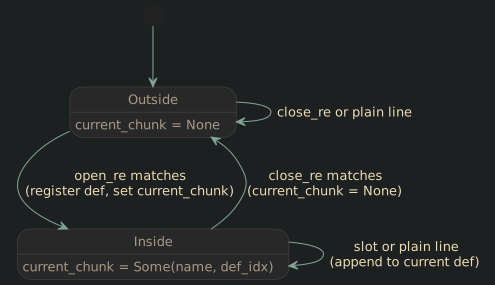
read scans a source text line-by-line, maintaining a simple three-state machine:
PlantUML diagram

@file chunks are registered in file_chunks on first appearance. Duplicate @file definitions without @replace are pushed to parse_errors in strict mode (fatal when write_files is called) or reported to stderr and skipped in permissive mode, keeping the first definition rather than silently clobbering it.

// <[noweb-chunkstore-read]>=
impl ChunkStore {
    pub fn read(&mut self, text: &str, file_idx: usize) {
        debug!("Reading text for file_idx: {}", file_idx);
        let mut current_chunk: Option<(String, usize)> = None;

        for (line_no, line) in text.lines().enumerate() {
            let bytes = line.as_bytes();
            // Fast reject: skip regex entirely when the open-delimiter bytes
            // are absent.  memmem uses SIMD and is much cheaper than the regex
            // NFA for the common case where most lines are plain prose or code.
            if memchr::memmem::find(bytes, &self.open_bytes).is_some() {
            } else {
                // No open delimiter — can only be a close marker or content.
                if memchr::memmem::find(bytes, &self.close_bytes).is_some()
                    && self.close_re.is_match(line)
                {
                    if let Some((ref cname, idx)) = current_chunk
                        && let Some(chunk) = self.chunks.get_mut(cname)
                        && let Some(def) = chunk.definitions.get_mut(idx)
                    {
                        def.def_end = Some(line_no);
                    }
                    current_chunk = None;
                } else if let Some((ref cname, idx)) = current_chunk
                    && let Some(chunk) = self.chunks.get_mut(cname)
                {
                    let def = chunk.definitions.get_mut(idx)
                        .expect("internal invariant: def_idx is valid");
                    if line.ends_with('\n') {
                        def.content.push(line.to_string());
                    } else {
                        def.content.push(format!("{}\n", line));
                    }
                }
                continue;
            }
            if let Some(caps) = self.open_re.captures(line) {
                let indentation = caps.name("indent").map_or("", |m| m.as_str());
                let base_name = caps.name("name").map_or("", |m| m.as_str()).to_string();
                debug!(
                    "Found open pattern: indentation='{}', base_name='{}'",
                    indentation, base_name
                );

                let is_replace = caps.name("replace").is_some();
                let is_file = caps.name("file").is_some();
                let full_name = if is_file {
                    format!("@file {}", base_name)
                } else {
                    base_name
                };

                if self.validate_chunk_name(&full_name, is_file) {
                    if full_name.starts_with("@file ") {
                        if self.chunks.contains_key(&full_name) && !is_replace {
                            let location = ChunkLocation { file_idx, line: line_no };
                            let err = ChunkError::FileChunkRedefinition {
                                file_chunk: full_name.clone(),
                                file_name: self
                                    .file_names
                                    .get(file_idx)
                                    .cloned()
                                    .unwrap_or_default(),
                                location,
                            };
                            if self.strict_undefined {
                                self.parse_errors.push(err);
                            } else {
                                eprintln!("{}", err);
                            }
                            continue;
                        }
                        if is_replace {
                            self.chunks.remove(&full_name);
                        }
                    } else if is_replace {
                        self.chunks.remove(&full_name);
                    }

                    let chunk = self
                        .chunks
                        .entry(full_name.clone())
                        .or_insert_with(NamedChunk::new);
                    let def_idx = chunk.definitions.len();
                    chunk.definitions.push(ChunkDef::new(
                        indentation.len(),
                        file_idx,
                        line_no,
                    ));

                    current_chunk = Some((full_name.clone(), def_idx));
                    if full_name.starts_with("@file ") && !self.file_chunks.contains(&full_name) {
                        self.file_chunks.push(full_name.clone());
                    }
                    debug!("Started chunk: {}", full_name);
                }
                continue;
            }

            if memchr::memmem::find(bytes, &self.close_bytes).is_some()
                && self.close_re.is_match(line)
            {
                if let Some((ref cname, idx)) = current_chunk
                    && let Some(chunk) = self.chunks.get_mut(cname)
                    && let Some(def) = chunk.definitions.get_mut(idx)
                {
                    def.def_end = Some(line_no);
                }
                current_chunk = None;
                continue;
            }

            if let Some((ref cname, idx)) = current_chunk
                && let Some(chunk) = self.chunks.get_mut(cname)
            {
                let def = chunk.definitions.get_mut(idx)
                    .expect("internal invariant: def_idx is valid");
                if line.ends_with('\n') {
                    def.content.push(line.to_string());
                } else {
                    def.content.push(format!("{}\n", line));
                }
            }
        }

        debug!("Finished reading. File chunks: {:?}", self.file_chunks);
    }
}
// @@

Expander

ExpandState bundles the mutable state that threads through the recursive expansion so that expand_inner does not exceed the argument-count limit. ExpandResult is a type alias for the three-tuple returned by expand_with_map.

expand_inner is the core recursive function. It takes a chunk name, the accumulated indentation prefix from all enclosing references, a mutable ExpandState reference, a reference location for error messages, and whether @reversed mode is active.

Each content line is either a slot (a chunk reference) or a plain line. For plain lines the base indentation recorded at parse time is stripped and target_indent is prepended; a NowebMapEntry is also produced so callers can reconstruct the source map. For slot lines, expand_inner recurses, extending the indent by the slot’s relative indentation within the definition.

The seen set provides O(1) cycle detection. A chunk name is inserted on descent and removed on return, so sibling references to the same chunk do not falsely trigger the cycle check. The parallel stack vector tracks the same entries in order, enabling readable cycle traces like A → B → C → A when a cycle is detected.

expand_inner is a pure function: it does not mutate ChunkStore state. Reference tracking is performed externally by inserting chunk names into the caller-provided referenced_chunks set, which check_unused_chunks then consults.

// <[noweb-chunkstore-expand]>=
/// Mutable state threaded through the recursive chunk expansion.
struct ExpandState {
    seen: HashSet<String>,
    /// Call stack (chunk names in descent order).  Its length is the current
    /// recursion depth, replacing a separate `depth` counter.
    stack: Vec<String>,
    referenced_chunks: HashSet<String>,
    /// Direct dependency edges collected during expansion:
    /// `(from_chunk, to_chunk, src_file)`.  Deduplicated via HashSet.
    deps: HashSet<(String, String, String)>,
}

impl ExpandState {
    fn new() -> Self {
        Self {
            seen: HashSet::new(),
            stack: Vec::new(),
            referenced_chunks: HashSet::new(),
            deps: HashSet::new(),
        }
    }
}

/// Return type of `expand_with_map`: expanded lines, source-map entries,
/// referenced chunk names, and direct dependency edges.
type ExpandResult = (Vec<String>, Vec<NowebMapEntry>, HashSet<String>, Vec<(String, String, String)>);

impl ChunkStore {
    fn expand_inner(
        &self,
        chunk_name: &str,
        target_indent: &str,
        state: &mut ExpandState,
        reference_location: ChunkLocation,
        reversed_mode: bool,
    ) -> Result<Vec<(String, NowebMapEntry)>, ChunkError> {
        if state.stack.len() > weaveback_core::MAX_RECURSION_DEPTH {
            let file_name = self
                .file_names
                .get(reference_location.file_idx)
                .cloned()
                .unwrap_or_default();
            return Err(ChunkError::RecursionLimit {
                chunk: chunk_name.to_string(),
                file_name,
                location: reference_location,
            });
        }

        if state.seen.contains(chunk_name) {
            let file_name = self
                .file_names
                .get(reference_location.file_idx)
                .cloned()
                .unwrap_or_default();
            let mut cycle = state.stack.clone();
            cycle.push(chunk_name.to_string());
            return Err(ChunkError::RecursiveReference {
                chunk: chunk_name.to_string(),
                cycle,
                file_name,
                location: reference_location,
            });
        }

        if !self.chunks.contains_key(chunk_name) {
            if self.strict_undefined {
                let file_name = self
                    .file_names
                    .get(reference_location.file_idx)
                    .cloned()
                    .unwrap_or_default();
                return Err(ChunkError::UndefinedChunk {
                    chunk: chunk_name.to_string(),
                    file_name,
                    location: reference_location,
                });
            }
            return Ok(Vec::new());
        }

        state.referenced_chunks.insert(chunk_name.to_string());

        let chunk = self.chunks.get(chunk_name)
            .expect("internal invariant: chunk exists after contains_key check");
        let defs = &chunk.definitions;

        // Collect indices so we can reverse without a Box<dyn Iterator>.
        let indices: Vec<usize> = if reversed_mode {
            (0..defs.len()).rev().collect()
        } else {
            (0..defs.len()).collect()
        };

        state.seen.insert(chunk_name.to_string());
        state.stack.push(chunk_name.to_string());
        let mut result = Vec::new();

        for def_idx in indices {
            let def = &defs[def_idx];
            let src_file = self
                .file_names
                .get(def.file_idx)
                .cloned()
                .unwrap_or_default();

            for (line_count, line) in def.content.iter().enumerate() {
                if let Some(caps) = memchr::memmem::find(line.as_bytes(), &self.open_bytes)
                    .and_then(|_| self.slot_re.captures(line))
                {
                    let add_indent = caps.get(1).map_or("", |m| m.as_str());
                    let modifier = caps.get(2).map_or("", |m| m.as_str());
                    let referenced_chunk = caps.get(3).map_or("", |m| m.as_str());

                    let line_is_reversed = modifier.contains("@reversed");
                    let relative_indent = if add_indent.len() > def.base_indent {
                        &add_indent[def.base_indent..]
                    } else {
                        ""
                    };
                    let new_indent = if target_indent.is_empty() {
                        relative_indent.to_owned()
                    } else {
                        format!("{}{}", target_indent, relative_indent)
                    };
                    let new_loc = ChunkLocation {
                        file_idx: def.file_idx,
                        line: def.line + line_count,
                    };

                    // Record the direct dependency edge before recursing.
                    state.deps.insert((
                        chunk_name.to_string(),
                        referenced_chunk.trim().to_string(),
                        src_file.clone(),
                    ));

                    let expanded = self.expand_inner(
                        referenced_chunk.trim(),
                        &new_indent,
                        state,
                        new_loc,
                        line_is_reversed,
                    )?;
                    result.extend(expanded);
                } else {
                    let line_indent = if line.len() > def.base_indent {
                        &line[def.base_indent..]
                    } else {
                        line
                    };
                    let out_line = if target_indent.is_empty() {
                        line_indent.to_owned()
                    } else {
                        format!("{}{}", target_indent, line_indent)
                    };
                    let entry = NowebMapEntry {
                        src_file: src_file.clone(),
                        chunk_name: chunk_name.to_string(),
                        src_line: (def.line + line_count + 1) as u32,
                        indent: target_indent.to_string(),
                        confidence: Confidence::Exact,
                    };
                    result.push((out_line, entry));
                }
            }
        }

        state.stack.pop();
        state.seen.remove(chunk_name);
        Ok(result)
    }

    pub fn expand_with_map(
        &self,
        chunk_name: &str,
        indent: &str,
    ) -> Result<ExpandResult, ChunkError> {
        let mut state = ExpandState::new();
        let loc = ChunkLocation { file_idx: 0, line: 0 };
        let pairs = self.expand_inner(chunk_name, indent, &mut state, loc, false)?;
        let (lines, entries) = pairs.into_iter().unzip();
        let deps: Vec<_> = state.deps.into_iter().collect();
        Ok((lines, entries, state.referenced_chunks, deps))
    }

    pub fn expand(&self, chunk_name: &str, indent: &str) -> Result<Vec<String>, ChunkError> {
        let (lines, _, _, _) = self.expand_with_map(chunk_name, indent)?;
        Ok(lines)
    }

    pub fn get_chunk_content(&self, chunk_name: &str) -> Result<Vec<String>, ChunkError> {
        self.expand(chunk_name, "")
    }
}
// @@

Utilities

After all @file chunks are written, check_unused_chunks warns about named chunks that were defined but never referenced — a common mistake when refactoring literate sources.

// <[noweb-chunkstore-utils]>=
impl ChunkStore {
    pub fn get_file_chunks(&self) -> &[String] {
        &self.file_chunks
    }

    pub fn has_chunk(&self, name: &str) -> bool {
        self.chunks.contains_key(name)
    }

    pub fn reset(&mut self) {
        self.chunks.clear();
        self.file_chunks.clear();
        self.file_names.clear();
    }

    /// Return a `ChunkDefEntry` for every chunk definition that has a recorded
    /// close-marker line.  Definitions where `def_end` is `None` (file ended
    /// without a close marker) are silently skipped.
    pub fn chunk_defs(&self) -> Vec<ChunkDefEntry> {
        let mut out = Vec::new();
        for (chunk_name, named_chunk) in &self.chunks {
            for (nth, def) in named_chunk.definitions.iter().enumerate() {
                let Some(def_end_0) = def.def_end else { continue };
                let src_file = self
                    .file_names
                    .get(def.file_idx)
                    .cloned()
                    .unwrap_or_default();
                out.push(ChunkDefEntry {
                    src_file,
                    chunk_name: chunk_name.clone(),
                    nth: nth as u32,
                    def_start: (def.line + 1) as u32,
                    def_end:   (def_end_0 + 1) as u32,
                });
            }
        }
        out
    }

    pub fn check_unused_chunks(&self, referenced: &HashSet<String>) -> Vec<String> {
        let mut warns = Vec::new();
        for (name, chunk) in &self.chunks {
            if !name.starts_with("@file ") && !referenced.contains(name)
                && let Some(first_def) = chunk.definitions.first()
            {
                let fname = self
                    .file_names
                    .get(first_def.file_idx)
                    .cloned()
                    .unwrap_or_default();
                let ln = first_def.line + 1;
                warns.push(format!(
                    "Warning: {} line {}: chunk '{}' is defined but never referenced",
                    fname, ln, name
                ));
            }
        }
        warns.sort();
        warns
    }
}
// @@

ChunkWriter

ChunkWriter borrows a SafeFileWriter and writes one @file chunk at a time. It dispatches on whether the expanded path is absolute or relative:

  • Relative paths — go through SafeFileWriter::before_write / after_write, which stage to a NamedTempFile, run the optional formatter, check the modification baseline, and atomically copy the result to gen/.

  • Absolute paths (only possible after tilde expansion of ~/…​ chunks) — written directly via fs::File::create. The allow_home flag in SafeWriterConfig gates this; without it the write is rejected as a SecurityViolation.

// <[noweb-chunkwriter]>=
pub struct ChunkWriter<'a> {
    safe_file_writer: &'a mut SafeFileWriter,
}

impl<'a> ChunkWriter<'a> {
    pub fn new(sw: &'a mut SafeFileWriter) -> Self {
        Self {
            safe_file_writer: sw,
        }
    }

    /// Write a single `@file` chunk.  Returns the final on-disk bytes (after
    /// any configured formatter has run) so the caller can use them for
    /// source-map remapping without an extra read.  Returns `None` for
    /// absolute-path chunks (written directly, not through `SafeFileWriter`).
    pub fn write_chunk(
        &mut self,
        chunk_name: &str,
        content: &[String],
    ) -> Result<Option<Vec<u8>>, WeavebackError> {
        if !chunk_name.starts_with("@file ") {
            return Ok(None);
        }
        let path_str = chunk_name["@file ".len()..].trim();
        let expanded = expand_tilde(path_str);
        let path = std::path::Path::new(&expanded);

        if path.is_absolute() {
            // @file ~/foo.rs tilde-expands to an absolute path outside gen/.
            // This is only allowed when allow_home is set; otherwise we refuse
            // rather than silently escape the sandbox.
            if !self.safe_file_writer.get_config().allow_home {
                return Err(WeavebackError::SafeWriter(
                    SafeWriterError::SecurityViolation(format!(
                        "writing outside gen/ requires --allow-home: {}",
                        path.display()
                    )),
                ));
            }
            if let Some(parent) = path.parent() {
                fs::create_dir_all(parent)?;
            }
            let mut f = fs::File::create(path)?;
            for line in content {
                f.write_all(line.as_bytes())?;
            }
            Ok(None)
        } else {
            let final_path = self.safe_file_writer.before_write(path_str)?;
            let mut f = fs::File::create(&final_path)?;
            for line in content {
                f.write_all(line.as_bytes())?;
            }
            let written = self.safe_file_writer.after_write(path_str)?;
            Ok(Some(written))
        }
    }
}
// @@

Clip

Clip composes ChunkStore and SafeFileWriter into the public API. Most methods delegate directly to one of the two inner types.

Constructor and read / query methods

// <[noweb-clip-core]>=
pub struct Clip {
    store: ChunkStore,
    writer: SafeFileWriter,
}

impl Clip {
    pub fn new(
        safe_file_writer: SafeFileWriter,
        open_delim: &str,
        close_delim: &str,
        chunk_end: &str,
        comment_markers: &[String],
    ) -> Self {
        Self {
            store: ChunkStore::new(open_delim, close_delim, chunk_end, comment_markers),
            writer: safe_file_writer,
        }
    }

    pub fn reset(&mut self) {
        self.store.reset();
    }

    /// Control whether referencing an undefined chunk is a fatal error (`true`)
    /// or silently expands to nothing (`false`, the default).
    pub fn set_strict_undefined(&mut self, strict: bool) {
        self.store.strict_undefined = strict;
    }

    pub fn has_chunk(&self, name: &str) -> bool {
        self.store.has_chunk(name)
    }

    pub fn get_file_chunks(&self) -> Vec<String> {
        self.store.get_file_chunks().to_vec()
    }

    pub fn check_unused_chunks(&self, referenced: &HashSet<String>) -> Vec<String> {
        self.store.check_unused_chunks(referenced)
    }

    pub fn read_file<P: AsRef<Path>>(&mut self, path: P) -> Result<(), WeavebackError> {
        let fname = path.as_ref().to_string_lossy().to_string();
        let idx = self.store.add_file_name(&fname);
        let text = if path.as_ref() == Path::new("-") {
            let mut buf = String::new();
            io::stdin().lock().read_to_string(&mut buf)?;
            buf
        } else {
            fs::read_to_string(&path)?
        };
        self.store.read(&text, idx);
        Ok(())
    }

    pub fn read(&mut self, text: &str, file_name: &str) {
        let idx = self.store.add_file_name(file_name);
        self.store.read(text, idx);
    }

    pub fn read_files<P: AsRef<Path>>(&mut self, input_paths: &[P]) -> Result<(), WeavebackError> {
        for path in input_paths {
            self.read_file(path)?;
        }
        Ok(())
    }

    pub fn get_chunk<W: io::Write>(
        &self,
        chunk_name: &str,
        out_stream: &mut W,
    ) -> Result<(), WeavebackError> {
        let lines = self.store.expand(chunk_name, "")?;
        for line in lines {
            out_stream.write_all(line.as_bytes())?;
        }
        out_stream.write_all(b"\n")?;
        Ok(())
    }

    pub fn expand(&self, chunk_name: &str, indent: &str) -> Result<Vec<String>, WeavebackError> {
        Ok(self.store.expand(chunk_name, indent)?)
    }

    pub fn get_chunk_content(&self, name: &str) -> Result<Vec<String>, ChunkError> {
        self.store.get_chunk_content(name)
    }
}
// @@

In-memory tangle check

tangle_check is a free function (no SafeFileWriter involved) that reads a set of source texts purely in memory and expands every @file chunk. It is the oracle used by the /__apply HTTP endpoint to verify that an edited chunk body still produces valid tangle output before the .adoc source file is modified.

// <[noweb-tangle-check]>=
/// Verify that `texts` tangle without errors.
///
/// Each element of `texts` is a `(source_text, filename)` pair — the same
/// inputs you would pass to [`Clip::read`].  Every `@file` chunk is expanded
/// in memory; no filesystem I/O is performed.
///
/// Returns a map from output file path (relative to `gen/`) to its expanded
/// lines on success, or the first expansion error encountered.
pub fn tangle_check(
    texts: &[(&str, &str)],
    open_delim: &str,
    close_delim: &str,
    chunk_end: &str,
    comment_markers: &[String],
) -> Result<HashMap<String, Vec<String>>, WeavebackError> {
    let mut store = ChunkStore::new(open_delim, close_delim, chunk_end, comment_markers);
    for (text, fname) in texts {
        let idx = store.add_file_name(fname);
        store.read(text, idx);
    }
    let mut out = HashMap::new();
    for name in store.get_file_chunks() {
        let lines = store.expand(name, "")?;
        let out_name = name.strip_prefix("@file ").unwrap_or(name).trim().to_string();
        out.insert(out_name, lines);
    }
    Ok(out)
}
// @@

Post-formatter remap

When a formatter (e.g. rustfmt) rewrites the output, the pre-formatter line numbers stored in the source map no longer correspond to the lines the user sees in their editor. remap_noweb_entries uses similar::TextDiff to build a mapping from post-formatter line indices back to pre-formatter line indices, then re-keys the NowebMapEntry vector accordingly.

The remap uses a three-tier strategy, applied in order, and assigns a Confidence level to each output line based on which tier attributed it:

  1. Diff anchor (Confidence::Exact): similar::TextDiff maps Equal lines exactly from pre- to post-formatter positions.

  2. Contextual content hash (Confidence::HashMatch): for lines still unattributed, match by a normalised (prev, curr, next) triple — three-line context rather than a single line. This eliminates false matches on trivial lines ({, }, etc.) and handles structure-preserving reorders such as import sorting. Ambiguous keys (same triple appearing in multiple pre-formatter lines from different chunks) are excluded from the hash map entirely: better no match than a wrong match.

  3. Bidirectional nearest-neighbour fill (Confidence::Inferred): remaining gaps are filled forward (prefer preceding source line) then backward (covers leading insertions prepended by the formatter).

Note

Attribution is approximate when a formatter makes large-scale semantic changes (e.g. merges or splits blocks). The Confidence field on NowebMapEntry lets callers distinguish exact mappings from inferred ones.

// <[noweb-remap]>=
/// Normalise a source line for content-hash matching:
/// strip leading/trailing whitespace and drop any trailing `//` comment.
fn normalise_for_hash(line: &str) -> &str {
    let trimmed = line.trim();
    // Drop inline // comment (not inside strings — good enough for heuristics).
    if let Some(pos) = trimmed.find("//") {
        trimmed[..pos].trim_end()
    } else {
        trimmed
    }
}

fn remap_noweb_entries(
    pre_lines: &[String],
    post_content: &str,
    entries: Vec<NowebMapEntry>,
) -> Vec<(u32, NowebMapEntry)> {
    use similar::{ChangeTag, TextDiff};
    use std::collections::{HashMap, HashSet};

    // Pre-normalise both sides once so all tiers can reuse the slices.
    let pre_norm: Vec<&str> = pre_lines.iter().map(|l| normalise_for_hash(l)).collect();
    let post_lines_vec: Vec<&str> = post_content.lines().collect();
    let post_norm: Vec<&str> = post_lines_vec.iter().map(|l| normalise_for_hash(l)).collect();
    let post_line_count = post_lines_vec.len();

    // --- Tier 1: diff-based exact mapping ---
    let pre_content: String = pre_lines.concat();
    let diff = TextDiff::from_lines(pre_content.as_str(), post_content);

    let mut old_to_new: Vec<Option<usize>> = vec![None; pre_lines.len()];
    let mut old_idx = 0usize;
    let mut new_idx = 0usize;

    for change in diff.iter_all_changes() {
        match change.tag() {
            ChangeTag::Equal => {
                if old_idx < old_to_new.len() {
                    old_to_new[old_idx] = Some(new_idx);
                }
                old_idx += 1;
                new_idx += 1;
            }
            ChangeTag::Delete => { old_idx += 1; }
            ChangeTag::Insert => { new_idx += 1; }
        }
    }

    let mut new_to_entry: Vec<Option<NowebMapEntry>> = vec![None; post_line_count];
    for (old_i, entry) in entries.iter().enumerate() {
        if let Some(&Some(new_i)) = old_to_new.get(old_i)
            && new_i < post_line_count
        {
            new_to_entry[new_i] = Some(entry.clone()); // Confidence::Exact from expand_inner
        }
    }

    // --- Tier 2: contextual content-hash fallback ---
    // Key = (prev_norm, curr_norm, next_norm).  Three-line context prevents
    // false matches on trivial lines ({, }, etc.).
    //
    // We store *all* candidate old indices per key (Vec<usize>) so that when
    // multiple pre-formatter lines share the same context triple (e.g. two
    // identical import lines in the same chunk), we pick the *closest unused*
    // one to the new_i position rather than arbitrarily using the last.
    //
    // Chunk-aware ambiguity rejection: if the same context triple spans lines
    // from *different* chunks, the key is discarded entirely — a cross-chunk
    // false match is worse than no match.
    type CtxKey<'a> = (&'a str, &'a str, &'a str);
    let mut hash_to_old: HashMap<CtxKey<'_>, Vec<usize>> = HashMap::new();
    let mut ambiguous: HashSet<CtxKey<'_>> = HashSet::new();

    for old_i in 0..pre_norm.len() {
        let curr = pre_norm[old_i];
        if curr.len() <= 1 { continue; }
        let prev = if old_i > 0 { pre_norm[old_i - 1] } else { "" };
        let next = pre_norm.get(old_i + 1).copied().unwrap_or("");
        let key: CtxKey<'_> = (prev, curr, next);
        if ambiguous.contains(&key) { continue; }
        if let Some(existing) = hash_to_old.get(&key) {
            // If any existing candidate is from a different chunk, discard.
            let first_chunk = &entries[existing[0]].chunk_name;
            if entries[old_i].chunk_name != *first_chunk {
                hash_to_old.remove(&key);
                ambiguous.insert(key);
                continue;
            }
        }
        hash_to_old.entry(key).or_default().push(old_i);
    }

    // Pre-claim lines already placed by tier 1.
    let mut claimed: HashSet<usize> = old_to_new.iter()
        .enumerate()
        .filter_map(|(i, m)| m.map(|_| i))
        .collect();

    for new_i in 0..post_line_count {
        if new_to_entry[new_i].is_some() { continue; }
        let curr = post_norm[new_i];
        if curr.len() <= 1 { continue; }
        let prev = if new_i > 0 { post_norm[new_i - 1] } else { "" };
        let next = post_norm.get(new_i + 1).copied().unwrap_or("");
        let key: CtxKey<'_> = (prev, curr, next);
        if let Some(candidates) = hash_to_old.get(&key) {
            // Pick the unclaimed candidate whose old position is closest to new_i.
            let best = candidates.iter()
                .filter(|&&old_i| !claimed.contains(&old_i))
                .min_by_key(|&&old_i| (new_i as isize - old_i as isize).abs());
            if let Some(&old_i) = best {
                claimed.insert(old_i);
                let mut entry = entries[old_i].clone();
                entry.confidence = Confidence::HashMatch;
                new_to_entry[new_i] = Some(entry);
            }
        }
    }

    // --- Tier 3: bidirectional nearest-neighbour fill (Confidence::Inferred) ---
    // Forward pass.
    let mut last: Option<NowebMapEntry> = None;
    for slot in new_to_entry.iter_mut() {
        if slot.is_some() {
            last = slot.clone();
        } else if let Some(ref src) = last {
            let mut e = src.clone();
            e.confidence = Confidence::Inferred;
            *slot = Some(e);
        }
    }
    // Backward pass: fill remaining gaps (leading insertions).
    let mut next: Option<NowebMapEntry> = None;
    for slot in new_to_entry.iter_mut().rev() {
        if slot.is_some() {
            next = slot.clone();
        } else if let Some(ref src) = next {
            let mut e = src.clone();
            e.confidence = Confidence::Inferred;
            *slot = Some(e);
        }
    }

    new_to_entry
        .into_iter()
        .enumerate()
        .filter_map(|(i, e)| e.map(|entry| (i as u32, entry)))
        .collect()
}
// @@

Writing files and dry-run

write_files iterates over every @file chunk, calls expand_with_map to get both the expanded lines and their NowebMapEntry source-map entries, writes the content through a ChunkWriter, then stores the source-map entries in the database’s noweb_map table.

After write_chunk runs (including any configured formatter), the formatted output is read back from disk. If it differs from the pre-formatter content, remap_noweb_entries re-keys the source-map entries using post-formatter line numbers. This ensures that perform_trace always receives line numbers consistent with the file the user sees in their editor.

After all files are written, unused-chunk warnings are emitted.

list_output_files resolves the same paths that write_files would write to, without touching the filesystem. It is used by --dry-run.

// <[noweb-clip-write]>=
impl Clip {
    /// Write all `@file` chunks, skipping those whose name is in `skip`.
    /// Skipped chunks do not expand or write; the source-map and chunk_deps
    /// entries for them are not updated (the previous run's entries remain).
    /// Chunk definitions for all chunks (including skipped ones) are still
    /// recorded so `weaveback serve` navigation stays accurate.
    pub fn write_files_incremental(
        &mut self,
        skip: &std::collections::HashSet<String>,
    ) -> Result<(), WeavebackError> {
        if self.store.strict_undefined && !self.store.parse_errors.is_empty() {
            return Err(WeavebackError::Chunk(
                self.store.parse_errors.remove(0),
            ));
        }
        let fc = self.store.get_file_chunks().to_vec();
        let mut all_referenced = HashSet::new();
        for name in &fc {
            if skip.contains(name) {
                continue;
            }
            let (lines, map_entries, referenced, deps) = self.store.expand_with_map(name, "")?;
            all_referenced.extend(referenced);

            let mut cw = ChunkWriter::new(&mut self.writer);
            let written_bytes = cw.write_chunk(name, &lines)?;

            let out_file = name.strip_prefix("@file ").unwrap_or(name).trim();

            let keyed = if let Some(bytes) = written_bytes {
                let formatted = String::from_utf8_lossy(&bytes);
                let pre_content: String = lines.concat();
                if formatted.as_ref() != pre_content {
                    remap_noweb_entries(&lines, formatted.as_ref(), map_entries)
                } else {
                    map_entries.into_iter().enumerate()
                        .map(|(i, e)| (i as u32, e)).collect()
                }
            } else {
                map_entries.into_iter().enumerate()
                    .map(|(i, e)| (i as u32, e)).collect()
            };

            self.writer
                .db_mut()
                .set_noweb_entries(out_file, &keyed)
                .map_err(|e| WeavebackError::SafeWriter(SafeWriterError::DbError(e)))?;

            self.writer
                .db_mut()
                .set_chunk_deps(&deps)
                .map_err(|e| WeavebackError::SafeWriter(SafeWriterError::DbError(e)))?;
        }
        let chunk_def_entries = self.store.chunk_defs();
        self.writer
            .db_mut()
            .set_chunk_defs(&chunk_def_entries)
            .map_err(|e| WeavebackError::SafeWriter(SafeWriterError::DbError(e)))?;

        let warns = self.store.check_unused_chunks(&all_referenced);
        for w in warns {
            eprintln!("{}", w);
        }
        Ok(())
    }

    pub fn write_files(&mut self) -> Result<(), WeavebackError> {
        // In strict mode, promote any parse-time errors (e.g. @file redefinition)
        // to hard errors before writing anything.
        if self.store.strict_undefined && !self.store.parse_errors.is_empty() {
            return Err(WeavebackError::Chunk(
                self.store.parse_errors.remove(0),
            ));
        }
        let fc = self.store.get_file_chunks().to_vec();
        let mut all_referenced = HashSet::new();
        for name in &fc {
            let (lines, map_entries, referenced, deps) = self.store.expand_with_map(name, "")?;
            all_referenced.extend(referenced);

            let mut cw = ChunkWriter::new(&mut self.writer);
            let written_bytes = cw.write_chunk(name, &lines)?;

            let out_file = name.strip_prefix("@file ").unwrap_or(name).trim();

            // After formatting, re-key map entries to post-formatter lines.
            // Use the bytes already returned by write_chunk — no second disk read.
            let keyed = if let Some(bytes) = written_bytes {
                let formatted = String::from_utf8_lossy(&bytes);
                let pre_content: String = lines.concat();
                if formatted.as_ref() != pre_content {
                    remap_noweb_entries(&lines, formatted.as_ref(), map_entries)
                } else {
                    map_entries.into_iter().enumerate()
                        .map(|(i, e)| (i as u32, e)).collect()
                }
            } else {
                map_entries.into_iter().enumerate()
                    .map(|(i, e)| (i as u32, e)).collect()
            };

            self.writer
                .db_mut()
                .set_noweb_entries(out_file, &keyed)
                .map_err(|e| WeavebackError::SafeWriter(SafeWriterError::DbError(e)))?;

            self.writer
                .db_mut()
                .set_chunk_deps(&deps)
                .map_err(|e| WeavebackError::SafeWriter(SafeWriterError::DbError(e)))?;
        }
        // Persist chunk definition line ranges for `weaveback serve` navigation.
        let chunk_def_entries = self.store.chunk_defs();
        self.writer
            .db_mut()
            .set_chunk_defs(&chunk_def_entries)
            .map_err(|e| WeavebackError::SafeWriter(SafeWriterError::DbError(e)))?;

        let warns = self.store.check_unused_chunks(&all_referenced);
        for w in warns {
            eprintln!("{}", w);
        }
        Ok(())
    }

    pub fn list_output_files(&self) -> Vec<std::path::PathBuf> {
        let gen_base = self.writer.get_gen_base();
        self.store
            .get_file_chunks()
            .iter()
            .map(|name| {
                let path_str = name.strip_prefix("@file ").unwrap_or(name).trim();
                let expanded = expand_tilde(path_str);
                let path = std::path::Path::new(&expanded);
                if path.is_absolute() {
                    path.to_path_buf()
                } else {
                    gen_base.join(path_str)
                }
            })
            .collect()
    }

    pub fn db(&self) -> &crate::db::WeavebackDb {
        self.writer.db()
    }

    pub fn db_mut(&mut self) -> &mut crate::db::WeavebackDb {
        self.writer.db_mut()
    }

    pub fn finish(self, target: &Path) -> Result<(), WeavebackError> {
        self.writer.finish(target).map_err(WeavebackError::SafeWriter)
    }
}
// @@

Assembly

The @file chunk assembles the module by expanding all sub-chunks in order. Imports are inlined here; the sub-chunks contain the type definitions and impl blocks.

// <[@file weaveback-tangle/src/noweb.rs]>=
use memchr;
use regex::Regex;
use std::collections::{HashMap, HashSet};
use std::fs;
use std::io::{self, Read, Write};
use std::path::{Component, Path};

use crate::db::{ChunkDefEntry, Confidence, NowebMapEntry};
use crate::safe_writer::SafeWriterError;
use crate::WeavebackError;
use crate::SafeFileWriter;
use log::debug;

// <[noweb-chunk-def]>
// <[noweb-errors]>
// <[noweb-named-chunk]>
// <[noweb-path-utils]>
// <[noweb-chunkstore-struct]>
// <[noweb-chunkstore-new]>
// <[noweb-chunkstore-read]>
// <[noweb-chunkstore-expand]>
// <[noweb-chunkstore-utils]>
// <[noweb-chunkwriter]>
// <[noweb-remap]>
// <[noweb-clip-core]>
// <[noweb-tangle-check]>
// <[noweb-clip-write]>
// @@