This document defines the migration from direct one-pass .adoc literate
sources to a two-pass, markup-neutral authoring model.
The goal is not to hide AsciiDoc. The goal is to move project-specific
literate intent into a small ¤ macro layer, then project that intent to
ordinary AsciiDoc and Markdown documents that can both be inspected, rendered,
and tangled.
This migration is also the execution path for
complexity reduction. A .wvb conversion
is not considered complete if it preserves a known bad structure unchanged.
During conversion, review source ownership, generated-file size, test placement,
and whether the document should remain canonical at all.
Current Model
Most sources are currently authored directly as .adoc files:
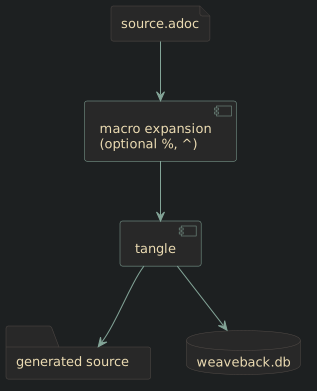
This is simple and bootstraps well, but it couples authoring to AsciiDoc syntax. It also makes Markdown output a conversion problem instead of a first-class projection.
Target Model
The target source format is .wvb: a markup-neutral weaveback document that
uses ¤ macros for portable structural constructs.
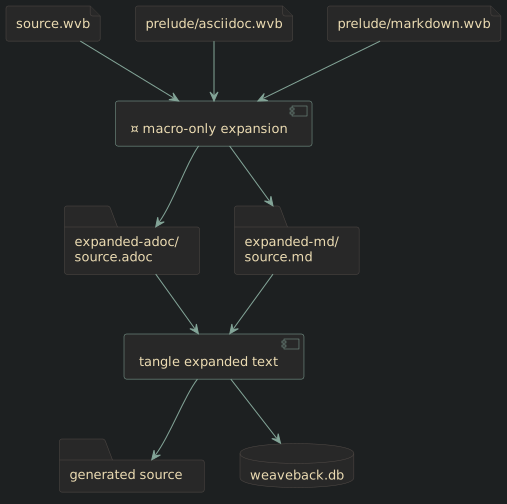
The .wvb source is the canonical authoring file. The expanded .adoc and
.md files are generated artifacts, but they are intentionally visible and may
be committed when useful for browsing the repository.
Invariants
The migration is safe only if these invariants hold:
-
.wvbfiles contain author intent;.adocand.mdexpanded files contain rendered markup projections of that intent. -
prelude/asciidoc.wvbandprelude/markdown.wvbexpose the same macro names and argument contracts. -
The
¤pass is macro-only. It should not write final source files directly. -
Final tangling operates on the expanded text, not on hidden evaluator state.
-
The same
.wvbsource expanded through AsciiDoc and Markdown must tangle to the same generated source for code-producing documents. -
Expanded directories are visible, not hidden. They are review artifacts, not implementation scratch space.
-
Existing
.adocsources remain valid during migration. Bootstrapping must not require the unfinished two-pass layer.
Prelude Contract
Both prelude implementations currently define:
-
¤code_block(language, body) -
¤h1(title) -
¤h2(title) -
¤h3(title) -
¤rust_chunk(name, body) -
¤graph(format, name, body) -
¤xref(target, label) -
¤note(body) -
¤code_doc(path, title, language, body) -
¤pastafarian_warning() -
¤rust_file(path, body)
¤rust_file(path, body) emits one Rust @file chunk and prepends the standard
generated-file path and safety warning comments:
¤rust_file(crates/demo/src/lib.rs, ¤[
pub fn answer() -> u8 {
    42
}
¤])
The AsciiDoc projection emits a source block. The Markdown projection emits a fenced code block. Both contain equivalent noweb chunks.
Pass Configuration
AsciiDoc projection:
[[pass]]
dir = "src-wvb/"
ext = "wvb"
sigil = "¤"
macro_prelude = ["prelude/asciidoc.wvb"]
expanded_ext = "adoc"
expanded_adoc_dir = "expanded-adoc"
open_delim = "<["
close_delim = "]>"
comment_markers = "//"
chunk_end = "@"
Markdown projection:
[[pass]]
dir = "src-wvb/"
ext = "wvb"
sigil = "¤"
macro_prelude = ["prelude/markdown.wvb"]
expanded_ext = "md"
expanded_md_dir = "expanded-md"
open_delim = "<["
close_delim = "]>"
comment_markers = "//"
chunk_end = "@"
During normal tangle mode, wb-tangle writes the expanded document and then
tangles the expanded text in the same logical pass. With macro_only = true,
it writes the expanded document and stops before tangling.
Migration Strategy
Phase 0: Stabilize the Two-Pass Mechanism
Status: in progress.
Required before converting real modules:
-
Keep
prelude/asciidoc.wvbandprelude/markdown.wvbsmall and parallel. -
Keep
docs/markup-prelude.adocas the reference for the macro surface. -
Keep a regression test proving that AsciiDoc and Markdown projections from the same
.wvbsource tangle to identical generated Rust. -
Ensure imported prelude changes invalidate incremental tangle output.
-
Keep current one-pass
.adocsources working.
Phase 1: Convert One Small Leaf Document
Status: pilot complete.
The first pilot is crates/weaveback-agent-core/src-wvb/lib.wvb. It generates
the same Rust as the former direct .adoc source and produces both
expanded-adoc/ and expanded-md/ projections.
For the next small leaf documents, pick low-risk files that generate one small Rust file and have few custom macro uses.
Conversion steps:
-
Decide whether
foo.adocis truly the canonical owner. -
If it is canonical, copy
foo.adoctofoo.wvb. -
If it is not canonical, remove fake assembly and convert it to architecture or user documentation instead.
-
Replace only structural markup with
¤macros. -
Preserve prose as plain text where possible.
-
Configure two projections for that directory: one AsciiDoc, one Markdown.
-
Generate
expanded-adoc/foo.adocandexpanded-md/foo.md. -
Verify both projections tangle to byte-identical generated source.
-
Delete or demote the original
.adoconce the.wvbpath is stable.
Do not start with process.adoc, block_parser.adoc, cli-spec, or any other
large control-plane file.
Phase 2: Add Component Macros Only Where They Reduce Noise
Component macros should encode recurring file structure, not hide logic.
Good candidates:
-
Rust file skeletons with standard generated-file warnings.
-
Python file skeletons, if Python sources remain generated from literate docs.
-
CLI option tables, if the data model remains readable in source.
-
Diagram blocks and cross-reference links.
Bad candidates:
-
Large prose sections.
-
Arbitrary Rust implementation bodies.
-
Control flow that makes the source harder to grep.
-
Macros whose only purpose is saving one or two lines.
Phase 3: Convert Medium Modules
After one leaf document survives normal development, convert modules with clear file boundaries:
-
review whether the current generated output should still be one file;
-
keep tests in separate chunks from implementation;
-
use accumulating chunks to avoid 2000+ line generated Rust files in one unreadable literate block;
-
keep generated
// <[chunk]>=and// @lines visually on their own lines; -
ensure both projections preserve identical chunk names and chunk order.
Each converted module must include a parity check, either by a unit test or by a repeatable local command documented next to the pass.
Phase 4: Convert Documentation-Heavy Sources
Only after code-producing sources are stable should we convert docs that are mostly prose.
This phase decides whether Markdown becomes a committed public browsing format
for the repository. If yes, expanded-md/ should be treated like generated
documentation: reproducible, reviewable, and periodically regenerated.
Phase 5: Retire Direct .adoc Authoring Where It No Longer Helps
Direct .adoc should remain available for files where AsciiDoc-specific
features are the point. The migration is not successful if it merely replaces
clear AsciiDoc with opaque macro calls.
Retire direct .adoc only when:
-
the
.wvbsource is shorter or clearer; -
both projections are useful;
-
generated source maps remain understandable;
-
the expanded output is deterministic;
-
bootstrap from a clean checkout is documented and tested.
Parity Checks
For every converted code-producing .wvb source, the required check is:
source.wvb + prelude/asciidoc.wvb  -> expanded-adoc/source.adoc -> generated file
source.wvb + prelude/markdown.wvb  -> expanded-md/source.md    -> generated file

generated file from AsciiDoc == generated file from Markdown
The current API regression test exercises this shape for a small Rust file. Larger converted modules should either reuse that helper pattern or gain a CLI-level smoke test.
Open Decisions
These should be decided by using the first migrated modules, not by guessing:
-
Whether
expanded-adoc/andexpanded-md/are committed globally or only for selected public-facing documents. -
Whether
.wvbshould allow raw AsciiDoc/Markdown sections, or whether all markup-specific syntax should be isolated behind¤macros. -
Whether component macros should live in one shared prelude or in per-language preludes such as
prelude/rust.wvbandprelude/python.wvb. -
Whether the doc renderer should render canonical
.wvb, expanded.adoc, expanded.md, or all three.
First Candidate
The first pilot migration is complete:
-
canonical source:
crates/weaveback-agent-core/src-wvb/lib.wvb -
AsciiDoc projection:
expanded-adoc/crates/weaveback-agent-core/src/lib.adoc -
Markdown projection:
expanded-md/crates/weaveback-agent-core/src/lib.md -
generated Rust:
crates/weaveback-agent-core/src/lib.rs
The next migration should still be small, but should exercise one additional complexity-reduction concern. A good next target is a small crate/module map where conversion can remove stale source-of-truth wording or clarify ownership.
Candidate criteria:
-
one generated
@file; -
simple tests;
-
no Python, LSP, SQLite, or CLI side effects;
-
no custom macro stack;
-
enough structure to benefit from
¤rust_file.
The purpose of the next migration is to validate that .wvb conversion can
also reduce structural complexity, not merely reproduce existing files.
Complexity Review Checklist
Apply this checklist to every .adoc → .wvb conversion:
-
Canonical owner: does this document truly own the generated file?
-
Generated size: will the generated file remain reviewable?
-
Module shape: should any chunks become separate Rust modules?
-
Test placement: are tests physically separated from runtime code where appropriate?
-
Projection value: is the generated Markdown useful for browsing?
-
Source maps: are expanded source paths deterministic and understandable?
-
Drift: does a full retangle leave no unexplained tracked diffs?