The evaluator is the macro-expansion engine of weaveback-macro. It walks the AST produced by the lexer+parser and resolves every macro call, variable reference, and conditional, emitting the expanded text.
Architecture overview
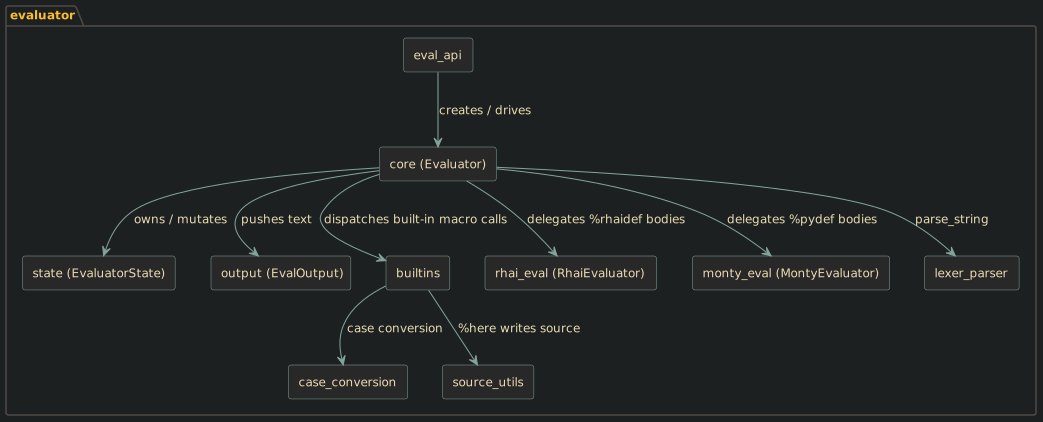
Design rationale
Dual evaluation paths
Evaluator exposes two evaluation paths:
-
evaluate(node) → String— the original path. Fast, zero overhead, used everywhere in built-in implementations. -
evaluate_to(node, &mut dyn EvalOutput)— the tracing path. Writes to a pluggable sink (PlainOutput,TracingOutput, orPreciseTracingOutput). Used by the MCP server’s oracle loop and for building themacro_mapdatabase table.
The two paths share scope management and parameter-binding logic; only the leaf "push text" calls differ.
Lexical scope via a stack of frames
Variables and macros live in a Vec<ScopeFrame>. Each macro call pushes a
new frame and pops it on exit; lookups walk the stack from top (inner) to
bottom (outer). This is simpler than a hash-chain and makes %export easy:
copy a binding one frame down.
Built-in dispatch before user macros
Evaluator holds a HashMap<String, BuiltinFn> (function pointers, not
closures). When a macro call node is encountered, the hash map is checked
first; only if the name is absent do we look in the scope stack for a
user-defined macro. This prevents user macros from shadowing built-ins.
Evaluation model
The evaluator is strict (call-by-value): all macro arguments are expanded
to strings before the macro body runs. At a %foo(a, b) call site the
sequence is:
-
A new
ScopeFrameis pushed onto the scope stack. -
Each argument node is evaluated left-to-right inside that new frame, producing a
String; the string is then bound to the corresponding formal parameter in the same frame. -
The macro body is evaluated inside the frame.
-
The frame is popped.
-
For
%rhaidef/%pydefmacros, the already-expanded body string is then passed to the Rhai or Python engine; there is no lazy re-expansion.
The critical subtlety about step 1: the scope is pushed before arguments are
evaluated. A %set(x, v) call inside an argument expression therefore mutates
the callee’s scope frame, not the caller’s. Those mutations disappear when
the frame is popped in step 4. This is intentional: arguments should not have
invisible caller-scope side effects. (Use %export to deliberately propagate
a value from the callee to the caller.)
Consequences worth knowing:
-
Eager, not lazy. Argument expressions are fully expanded before the body runs, so argument side-effects fire in left-to-right call order.
-
Argument side-effects are scoped.
%setinside an argument lives in the callee’s frame and does not bleed into the caller (see above). -
Recursion depth limit. A macro calling itself (directly or indirectly) will hit
MAX_RECURSION_DEPTHand return a runtime error rather than stack-overflow. -
early_exitstops everything. Once%heresetsearly_exit = true, every subsequent call toevaluate()orevaluate_to()returns an empty string immediately. No further macro calls, no further argument evaluation, no further output — the file is considered fully processed.
Script back-ends as pluggable singletons
RhaiEvaluator (Rhai) and MontyEvaluator (Python via monty) live as fields
on Evaluator. The Rhai engine is allocated once; the persistent store
(rhai_store, py_store) is a HashMap that survives across calls so scripts
can accumulate state.
Submodule roles
| Document | Role |
|---|---|
All mutable state: |
|
Output-sink abstraction: |
|
Main evaluation engine: |
|
Built-in macros ( |
|
Script back-ends: |
|
Thin public API: |
This file generates
-
mod.rs— module declarations and public re-exports -
errors.rs—EvalErrorenum andEvalResulttype alias -
lexer_parser.rs— glue functionlex_parse_contentthat chains the lexer, parser, and AST builder
File structure
// <<@file weaveback-macro/src/evaluator/mod.rs>>=
// <<evaluator mod preamble>>
// @

// <<@file weaveback-macro/src/evaluator/errors.rs>>=
// <<evaluator errors>>
// @

// <<@file weaveback-macro/src/evaluator/lexer_parser.rs>>=
// <<evaluator lexer parser>>
// @
Module preamble (mod.rs)
mod.rs declares the private submodules, the public tests module under
#[cfg(test)], and re-exports every public symbol that the rest of the crate
(and external callers) needs. Keeping re-exports here means importers never
have to know which submodule owns a type.
// <<evaluator mod preamble>>=
// crates/weaveback-macro/src/evaluator/mod.rs
// Re-export everything needed by the rest of the crate
pub use crateASTNode;
pub use Evaluator;
pub use ;
pub use ;
pub use lex_parse_content;
pub use MontyEvaluator;
pub use ;
pub use RhaiEvaluator;
pub use ;
// @Error types (errors.rs)
EvalError covers every failure mode that can occur during expansion.
IoError uses #[from] so ? works on std::io::Error inside built-ins.
The blanket From<String> impl lets built-in functions return
Err("message".into()) without naming a specific variant.
// <<evaluator errors>>=
// crates/weaveback-macro/src/evaluator/errors.rs
use Error;
pub type EvalResult<T> = ;
// @Lexer-parser glue (lexer_parser.rs)
lex_parse_content is a thin orchestrator that runs the three pipeline stages
— Lexer, Parser, and process_ast — in sequence. It lives here rather
than in each call site so the three stages are always invoked in the right
order with the right error formatting.
The LineIndex is built once from the source bytes and shared across both
lexer-error formatting and the parser; it avoids repeated line-number
computation.
// <<evaluator lexer parser>>=
// weaveback/crates/weaveback-macro/src/evaluator/lexer_parser.rs
use crateLexer;
use crateLineIndex;
use crateParser;
use crateASTNode;
// @